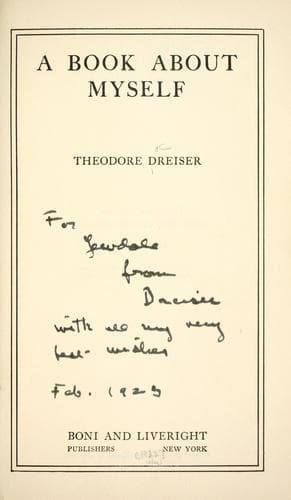
Dreiser, Theodore, 1871-1945; Journalists -- United States -- Biography; Novelists, American -- 20th century -- Biography
The men at the front, the puddlers, were the labor princes of this realm
and yet among the hardest worked. A puddling or blast furnace was a
brick structure like an oven, about seven feet high and six feet square,
with two compartments, one a receptacle into which pigiron was thrown,
the other a fuel chamber where the melting heat was generated. The
drafts were so arranged that the flame swept from the fuel chamber
directly upon the surface of the iron. From five to six hundred pounds
of pigiron were put into each furnace at one time, after which it was
closed and sufficient heat applied to melt down the iron. Then the
puddler began to work it with an iron rod through a hole in the furnace
door, so as to stir up the liquid and bring it in contact with the air.
As the impurities became separated from the iron and rose to the top as
slag, they were tipped out through a center notch. As it became freer
from impurities, a constantly higher temperature was required to keep
the iron in a liquid condition. Gradually it began to solidify in
granules, much as butter forms in churning. Later it took on or was
worked into large malleable balls or lumps or rolls like butter, three
to any given “charge” or furnace. Then, while still in a comparatively
soft but not molten condition, these were taken out and thrown across a
steel floor to a “taker” to be worked by other machinery and other
processes.
Puddling was a full-sized man’s job. There were always two, and
sometimes three, to a single furnace, and they took turns at working the
metal, as a rule ten minutes to a turn. No man could stand before a
furnace and perform that back-breaking toil continually. Even when
working by spells a man was often nearly exhausted at the end of his
spell. As a rule he had to go outside and sit on a bench, the
perspiration running off him. The intensity of the heat in those days
(1893) was not as yet relieved by the device of shielding the furnace
with water-cooled plates. The wages of these men was in the neighborhood
of three dollars a day, the highest then paid. Before the great strike
it had been more.
Public-domain text, read in full here on John Shaqi.
Reviews
Reviews
No reviews yet
Be the first to share your thoughts on this work.
Elsewhere in the archive
Join the Discussion
Join the discussion
Sign in to leave a comment or review.
Sign InorCreate an account