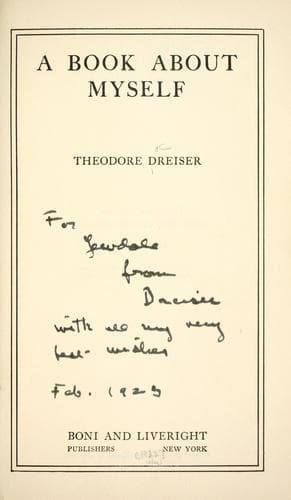
Dreiser, Theodore, 1871-1945; Journalists -- United States -- Biography; Novelists, American -- 20th century -- Biography
The convention opened its sessions the next day, and because of my
seeming cleverness I was given a front seat in the press-stand, where I
could hear all speeches, observe the crowd, trade ideas with the best
newspaper men in the city and the country. In a day, if you will believe
it, and in spite of the fact that I was getting only fifteen dollars a
week, my stock had risen so that, in this one office at least, I was
looked upon as a newspaper man of rare talent, an extraordinarily bright
boy sure to carve out a future for himself, one to be made friends with
and helped. Here in this press-stand I was now being coached by one
newspaper man and another in the intricacies of convention life. I was
introduced to two other members of our staff who were supposed to be
experienced men, both of them small, clever, practical-minded
individuals well adapted to the work in hand. One of them, Harry L.
Dunlap, followed my errant fortunes for years, securing a place through
me in St. Louis and rising finally to be the confidential adviser of one
of our Presidents, William Howard Taft—a not very remarkable President
to be adviser to at that. The other, a small brown-suited soul, Brady by
name, came into my life for a very little while and then went, I know
not where.
But this convention, how it thrilled me! To be tossed into the vortex of
national politics at a time when the country was seething over the
possible resuscitation of the old Democratic party to strength and power
was something like living. I listened to the speeches, those dully
conceived flights and word gymnastics and pyrotechnics whereby backwoods
statesmen, district leaders and personality-followers seek to foist upon
the attention of the country their own personalities as well as those of
the individuals whom they admire. Although it was generally known that
Cleveland was to be nominated (the money power of America having fixed
upon him) and it was useless to name any one else, still as many as ten
different “statesmen” great leaders, saviors were put in nomination.
Each man so mentioned was the beau ideal of a nation’s dream of a
leader, a statesman, a patriot, lover of liberty and of the people. This
in itself was a liberal education and slowly but surely opened my eyes.
I watched with amazement this love of fanfare and noise, the way in
which various delegations and individual followers loved to shout and
walk up and down waving banners and blowing horns. Different States or
cities had sent large delegations, New York a marching club two thousand
strong, all of whom had seats in this hall, and all were plainly
instructed to yell and demonstrate at the mention of a given name.
Public-domain text, read in full here on John Shaqi.
Reviews
Reviews
No reviews yet
Be the first to share your thoughts on this work.
Join the Discussion
Join the discussion
Sign in to leave a comment or review.
Sign InorCreate an account