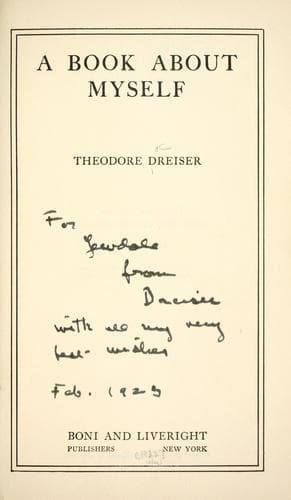
Dreiser, Theodore, 1871-1945; Journalists -- United States -- Biography; Novelists, American -- 20th century -- Biography
The one thing I heard which seemed rather important at the time,
beautiful, because of a man’s voice and gestures, was a speech by Bourke
Cochran, exhorting the convention to nominate his candidate, David
Bennett Hill, and save the party from defeat. Indeed his speech, until
later I heard William Jennings Bryan, seemed to me the best I had ever
heard, clear, sonorous, forcible, sensible. He had something to say and
he said it with art and seeming conviction. He had presence too, a sort
of Herculean, animal-like effrontery. He made his audience sit up and
pay attention to him, when as a matter of fact it was interested in
talking privately, one member to another. I tried to take notes of what
he was saying until one of my associates told me that the full minutes
of his speech could soon be secured from the shorthand reporters.
Being in this great hall cheek by jowl with the best of the Chicago
newspaper world thrilled me. “Now,” I said to myself, “I am truly a
newspaper man. If I can only get interesting things to write about, my
fortune is made.” At once, as the different forceful reporters of the
city were pointed out to me (George Ade, Finley Peter Dunne, “Charlie”
Seymour, Charles d’Almy), my neck swelled as does a dog’s when a rival
appears on the scene. Already, at mere sight of them, I was anxious to
try conclusions with them on some important mission and so see which of
us was the better man. Always, up to the early thirties, I was so human
as to conceive almost a deadly opposition to any one who even looked as
though he might be able to try conclusions with me in anything. At that
time, I was ready for a row, believing, now that I had got thus far,
that I was destined to become one of the greatest newspaper men that
ever lived!
But this convention brought me no additional glory. I did write a
flowery description of the thing as a whole, but only a portion of it
was used. I did get some details of committee work, which were probably
incorporated in the political man’s general summary. The next day,
Cleveland being nominated, interest fell off. Thousands packed their
bags and departed. I was used for a day or two about hotels gathering
one bit of news and another, but I could see that there was no import to
what I was doing and began to grow nervous lest I should be summarily
dropped. I spoke to Maxwell about it.
“Do you think they’ll drop me?” I asked.
“Not by a damned sight!” he replied contentiously. “You’ve earned a show
here; it’s been promised you; you’ve made good, and they ought to give
it to you. Don’t you say anything; just leave it to me. There’s going to
be a conference here tomorrow as to who’s to be dropped and who kept on,
and I’ll have my say then. You saved the day for us on that nomination
stuff, and that ought to get you a show. Leave it to me.”
Public-domain text, read in full here on John Shaqi.
Reviews
Reviews
No reviews yet
Be the first to share your thoughts on this work.
Join the Discussion
Join the discussion
Sign in to leave a comment or review.
Sign InorCreate an account