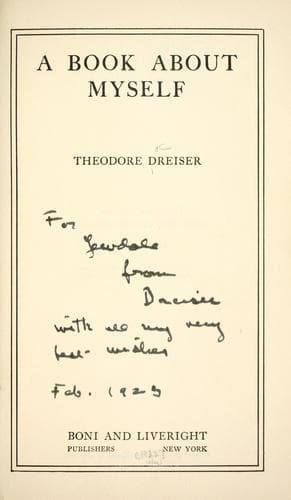
Dreiser, Theodore, 1871-1945; Journalists -- United States -- Biography; Novelists, American -- 20th century -- Biography
Why, I could write reams upon any topic when at last I discovered that I
could write at all. One day some one—Maxwell, I suppose—hearing me speak
of what I was seeing each day as I came to or went from the office to my
room, suggested that I do an article on Chicago’s vilest slum, which lay
between Halsted and the river, Madison and Twelfth streets, for the next
Sunday issue, and this was as good as meat and drink for me. I visited
this region a few times between one and four in the morning, wandering
about its clattering boardwalks, its dark alleys, its gloomy mire and
muck atmosphere. Chicago’s wretchedness was never utterly tame,
disconsolate or hang-dog, whatever else it might be; rather, it was
savage, bitter and at times larkish and impish. The vile slovens,
slatterns, prostitutes, drunkards and drug fiends who infested this
region all led a strident if beggarly or horrible life. Saloon lights
and smells and lamps gleaming smokily from behind broken lattices and
from below wooden sidewalk levels, gave it a shameless and dangerous
color. Accordions, harmonicas, jew’s-harps, clattering tin-pan pianos
and stringy violins were forever going; paintless rotting shacks always
resounded with a noisy blasphemous life between twelve and four; oaths,
foul phrases; a Hogarthian shamelessness and reconciliation to filth
everywhere—these were some of the things that characterized it. Although
there was a closing-hour law there was none here as long as it was
deemed worth while to keep open. Only at four and five in the morning
did a heavy peace seem to descend, and this seemed as wretched as the
heavier vice and degradation which preceded it.
In the face of such a scene or picture as this my mind invariably paused
in question. I had been reared on dogmatic religious and moral theory,
or at least had been compelled to listen to it all my life. Here then
was a part of the work of an omnipotent God, who nevertheless tolerated,
apparently, a most industrious devil. Why did He do it? Why did nature,
when left to itself, devise such astounding slums and human muck heaps?
Harlots in doorways or behind windows or under lamp-posts in these
areas, smirking and signaling creatures with the dullest or most
fox-like expression and with heavily smeared lips and cheeks and
blackened eyebrows, were ready to give themselves for one dollar, or
even fifty cents, and this in the heart of this budding and prosperous
West, a land flowing with milk and honey! What had brought that about so
soon in a new, rich, healthy, forceful land—God? devil? or both working
together toward a common end? Near at hand were huge and rapidly
expanding industries. The street-cars and trains, morning and evening,
were crowded with earnest, careful, saving, seeking, moderately
well-dressed people who were presumably anxious to work and lay aside a
competence and own a home. Then why was it that these others lived in
such a hell? Was God to blame? Or society?
Public-domain text, read in full here on John Shaqi.
Reviews
Reviews
No reviews yet
Be the first to share your thoughts on this work.
Join the Discussion
Join the discussion
Sign in to leave a comment or review.
Sign InorCreate an account