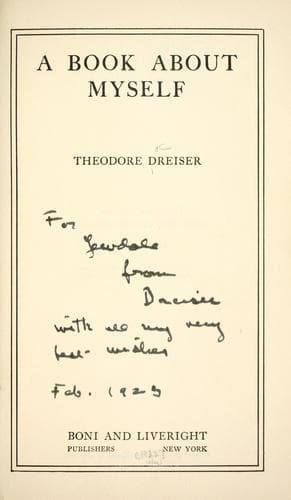
Dreiser, Theodore, 1871-1945; Journalists -- United States -- Biography; Novelists, American -- 20th century -- Biography
Salary or no salary, however, I was now a newspaper man, with the
opportunity eventually to make a name for myself. Having broken with the
family and with my sister C——, I was now quite alone in the world and
free to go anywhere and do as I pleased. I found a front room in Ogden
Place overlooking Union Park (in which area I afterwards placed one of
my heroines). I could walk from here to the office in a little over
twenty minutes. My route lay through either Madison Street or Washington
Boulevard east to the river, and morning and night I had ample
opportunity to speculate on the rancid or out-at-elbows character of
much that I saw. Both Washington and Madison, from Halsted east to the
river, were lined with vile dens and tumbledown yellow and gray frame
houses, slovenly, rancorous, unsolved and possibly unsolvable misery and
degeneracy, whole streets of degraded, dejected, miserable souls. Why
didn’t society do better by them? I often asked of myself then. Why
didn’t they do better by themselves? Did God, who, as had been drummed
into me up to that hour was all wise, all merciful, omnipresent and
omnipotent make people so or did they themselves have something to do
with it? Was government to blame, or they themselves? Always the
miseries of the poor, the scandals, corruptions and physical
deteriorations which trail folly, weakness, uncontrolled passion
fascinated me. I was never tired of looking at them, but I had no
solution and was not willing to accept any, suspecting even then that
man is the victim of forces over which he has no control. As I walked
here and there through these truly terrible neighborhoods, I peered
through open doors and patched and broken windows at this wretchedness
and squalor, much as a man may tread the poisonous paths of a jungle,
curious and yet fearsome.
It was this nosing and speculative tendency, however, which helped me
most, as I soon found. Journalism, even in Chicago, was still in that
discursive stage which loved long-winded yarns upon almost any topic.
Nearly all news stories were padded to make more of them than they
deserved, especially as to color and romance. All specials were being
written in imitation of the great novelists, particularly Charles
Dickens, who was the ideal of all newspaper men and editors as well as
magazine special writers (how often have I been told to imitate Charles
Dickens in thought and manner!). The city editors wanted not so much
bare facts as feature stories, color, romance; and, although I did not
see it clearly at the time, I was their man.
Write?
Public-domain text, read in full here on John Shaqi.
Reviews
Reviews
No reviews yet
Be the first to share your thoughts on this work.
Join the Discussion
Join the discussion
Sign in to leave a comment or review.
Sign InorCreate an account