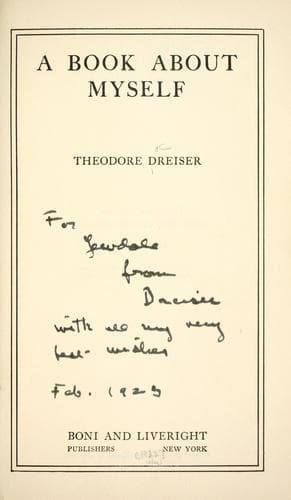
Dreiser, Theodore, 1871-1945; Journalists -- United States -- Biography; Novelists, American -- 20th century -- Biography
MY connection with the _Globe-Democrat_ had many aspects, chief among
which was my rapidly developing consciousness of the significance of
journalism and its relation to the life of the nation and the state. My
journalistic career had begun only five months before and preceding that
I had had no newspaper experience of any kind. The most casual reader of
a newspaper would have been as good as I in many respects.
But here I rather sensed the significance of it all, the power of a man
like McCullagh, for instance, for good or evil, the significance of a
man like Butler in this community. I still had a lot to learn: the
extent of graft in connection with politics in a city, the power of a
newspaper to make sentiment in a State and so help to carry it for a
Governor or a President. The political talk I heard on the part of one
newspaper man and another “doing politics,” as well as the leading
editorials in this and other papers, which just at this time were
concerned with a coming mayoralty fight and a feud in the State between
rival leaders of the Republican party, completely cleared up the
situation for me. I listened to all the gossip, read the papers
carefully, wondered over the personalities and oddities of State
governments in connection with our national government. Just over the
river in Illinois everybody was concerned with the administration of
John P. Altgeld, governor of the State, and whether he would pardon the
Chicago anarchists whose death sentences, recorded a few years before,
had been commuted to life imprisonment. On this side of the river
everybody was interested in the administration of William Joel Stone,
who was the governor. A man by the name of Cyrus H. Walbridge was
certain to be the next mayor if the Republicans won, and according to
the _Globe_, they ought to win because the city needed to be reformed.
The local Democratic board of aldermen was supposed to be the most
corrupt in all America (how many cities have yearly thought that, each
of its governing body, since the nation began!), and Edward Noonan, the
mayor, was supposed to be the lowest and vilest creature that ever stood
up in shoes. The chief editorials of the _Globe_ were frequently
concerned with blazing denunciations of him. As far as I could make out,
he had joined with various corporations and certain members of council
to steal from the city, sell its valuable franchises for a song and the
like. He had also joined with the police in helping bleed the saloons,
gambling dens and houses of prostitution. Gambling and prostitution were
never so rampant as now, so our good paper stated. The good people of
the city should join and help save the city from destruction.
How familiar it all sounds, doesn’t it? Well, this was 1892, and I have
heard the same song every year since, in every American city in which I
have ever been. Gambling, prostitution, graft, _et cetera_, must be
among our national weaknesses, not?
Public-domain text, read in full here on John Shaqi.
Reviews
Reviews
No reviews yet
Be the first to share your thoughts on this work.
Elsewhere in the archive
Join the Discussion
Join the discussion
Sign in to leave a comment or review.
Sign InorCreate an account