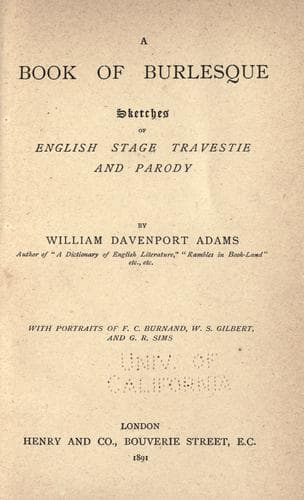
A Book of Burlesque: Sketches of English Stage Travestie and ParodyAdams, William Davenport
History
A Book of Burlesque: Sketches of English Stage Travestie and Parody
Adams, William Davenport
Burlesque (Literature); English literature -- History and criticism; Parody
In mathematics Woman leads the way!
The narrow-minded pedant still believes
That two and two make four! Why, we can prove--
We women, household drudges as we are--
That two and two make five--or three--or seven--
Or five-and-twenty, as the case demands!...
Diplomacy? The wily diplomate
Is absolutely helpless in our hands:
He wheedles monarchs--Woman wheedles him!
Logic? Why, tyrant man himself admits
It's waste of time to argue with a woman!
Then we excel in social qualities--
Though man professes that he holds our sex
In utter scorn, I'll undertake to say
If you could read the secrets of his heart,
He'd rather be alone with one of you
Than with five hundred of his fellow-men!
In all things we excel. Believing this,
Five hundred maidens here have sworn to place
Their foot upon his neck. If we succeed,
We'll treat him better than he treated us;
But if we fail--oh, then let hope fail too!
Let no one care one penny how she looks!
Let red be worn with yellow--blue with green,
Crimson with scarlet--violet with blue!
Let all your things misfit, and you yourselves
At inconvenient moments come undone!
Let hair-pins lose their virtue; let the hook
Disdain the fascination of the eye,--
The bashful button modestly evade
The soft embraces of the buttonhole!
Let old associations all dissolve,
Let Swan secede from Edgar--Grant from Gask,
Sewell from Cross--Lewis from Allenby--
In other words, let Chaos come again!
Into the region of the Ballad the comic playwrights have made
comparatively few incursions. "The Babes in the Wood," "Lord Bateman,"
"Billy Taylor," "Villikins and his Dinah," and "Lord Lovel,"--these are
the stories which have been most in favour with burlesque purveyors.
R. J. Byron took up the first-named subject in 1859, when the company
at the Adelphi (where the piece was produced) included Miss Woolgar
(Sir Rowland Macassar), Mr. Toole and Miss Kate Kelly (the Babes), Paul
Bedford (the First Ruffian), and Mrs. Billington (the Lady Macassar).
Then, in 1877, there came a provincial version by Messrs. G. L. Gordon
and G. W. Anson; and, next, in 1884, at Toole's Theatre, the "Babes"
of Mr. Harry Paulton, in which Mr. Edouin and Miss Atherton were the
central figures. The first travestie of "Lord Bateman" was made by
Charles Selby at the Strand in 1839; then there was the production by
R. B. Brough in 1854 at the Adelphi; and, still later, there was the
piece by H. J. Byron, at the Globe (1869). Passing over the "Billy
Taylor" of Buckstone (1829), we arrive at "The Military Billy Taylor"
of Mr. Burnand, which came out forty years later. It is to Mr. Burnand,
also, that we owe "Villikins and his Dinah," played by amateurs at
Cambridge, as well as "Lord Lovel and the Lady Nancy Bell," which he
wrote for the same place and performers.
X.
THE NEW BURLESQUE.
Public-domain text, read in full here on John Shaqi.
Reviews
Reviews
No reviews yet
Be the first to share your thoughts on this work.
Elsewhere in the archive
Join the Discussion
Join the discussion
Sign in to leave a comment or review.
Sign InorCreate an account