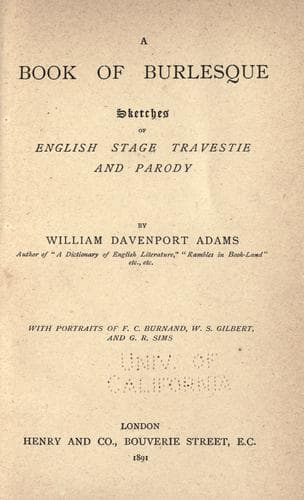
A Book of Burlesque: Sketches of English Stage Travestie and ParodyAdams, William Davenport
History
A Book of Burlesque: Sketches of English Stage Travestie and Parody
Adams, William Davenport
Burlesque (Literature); English literature -- History and criticism; Parody
With the year 1885 there dawned a new epoch for stage travestie in
England. The old Gaiety company had broken up, Miss Farren alone
remaining; and with the accession of fresh blood there came fresh
methods. The manager who had succeeded Mr. Hollingshead recognised the
tendencies of the times; and with "Little Jack Sheppard"--a travestie
by Messrs. Stephens and Yardley of the well-known story, familiar both
in fiction and in drama--a novel departure was made.
In the "palmy" days, burlesque had not, as a rule, formed the whole of
an evening's entertainment. The one-act travestie had grown on occasion
into two and even three acts; but, until recent years, the one act (in
several scenes) had usually been deemed sufficient, the remainder of
the programme being devoted to comedy or drama. The musical part of the
performance had generally been made up of adaptations or reproductions
of popular airs of the day--either comic songs or operatic melodies:
very rarely had the music been special and original. The scenery had
never been particularly remarkable; nor, save during the various
_régimes_ of Vestris, had there been any special splendour in the
dresses. For the most part, the old school of burlesque did not rely
upon a brilliant _mise-en-scène_. In the prologue to his "Alcestis,"
produced just forty-one years ago, we find Talfourd expressly drawing
attention to the simplicity of the stage show. Speaking of the
productions at the houses of serious drama, he said:--
Plays of the greatest and the least pretence
Are mounted so regardless of expense
That fifty nights is scarce a run accounted--
Run! They should gallop, being so well _mounted_
But with "Alcestis" it was to be different:--
What you enjoy must be all "on the quiet."
No horse will pull _our_ play up if it drag,
No banners when our wit is on the flag;
No great effects or new-imported dance
The drooping eye will waken and entrance; ...
But an old story from a classic clime,
Done for the period into modern rhyme.
A very different policy was to characterise the New Burlesque. The
pieces, having now become the staple of the night's amusement, were to
be placed upon the boards with all possible splendour. Money was to
be spent lavishly on scenery, properties and costumes. Dancing was to
be a prominent feature--not the good old-fashioned "breakdowns" and
the like, but choreographic interludes of real grace and ingenuity.
The music was to be written specially for the productions, and pains
were to be taken to secure artists who could really sing. Something
had already been done in each of these directions. So long ago as
1865 Mr. Burnand's "Windsor Forest" had been fitted with wholly new
music; and at the Gaiety, under Mr. Hollingshead, burlesque had grown
in elaborateness year by year. Not, however, till the production of
"Little Jack Sheppard," in 1885, had the elaboration been so marked and
complete in all departments.
Public-domain text, read in full here on John Shaqi.
Reviews
Reviews
No reviews yet
Be the first to share your thoughts on this work.
Elsewhere in the archive
Join the Discussion
Join the discussion
Sign in to leave a comment or review.
Sign InorCreate an account