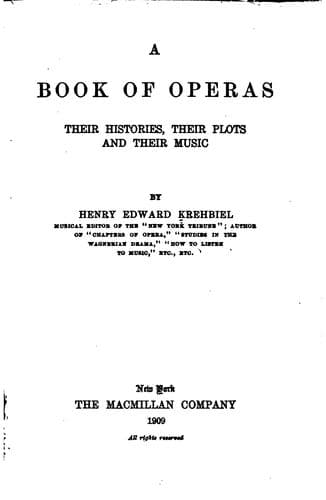
A Book of Operas: Their Histories, Their Plots, and Their MusicKrehbiel, Henry Edward
History
A Book of Operas: Their Histories, Their Plots, and Their Music
Krehbiel, Henry Edward
Operas -- Stories, plots, etc.
day, life, and memory contemned. In this dialogue lies the key
to the philosophy which Wagner has proclaimed in the tragedy. In
Wagner's exposition of the prelude we saw that he wishes us to
observe "the one glimmering of the highest bliss of attainment" in
the "surrender of being," the "final redemption into that wondrous
realm from which we wander farthest when we try to take it by
force." For this realm he chooses death and night as symbols, but
what he means to imply is the nirvana of Buddhistic philosophy, the
final deliverance of the soul from transmigration. Such love as
that of Tristan and Isolde presented itself to Wagner as ceaseless
struggle and endless contradiction, and for this problem nirvana
alone offers a happy outcome; it means quietude and identity.
In vain does Brangäne sing her song of warning from the tower;
the lovers have been transported beyond all realization of their
surroundings; they sing on, dream on in each other's arms, until
at the moment of supremest ecstasy there comes a rude interruption.
Kurwenal dashes in with a sword and a shout: "Save thyself,
Tristan!" the king, Melot, and courtiers at his heels. Day, symbol
of all that is fatal to their love, has dawned. Tristan is silent,
though Marke bewails the treachery of his nephew and his friend.
From the words of the heart-torn king we learn that he had been
forced into the marriage with Isolde by the disturbed state of his
kingdom, and had not consented to it until Tristan, whose purpose
it was thus to quiet the jealous anger of the barons, had threatened
to depart from Cornwall unless the king revoked his purpose to make
him his successor, and took unto himself a wife. Tristan's answer to
the sorrowful upbraidings of his royal uncle is to obtain a promise
from Isolde to follow him into the "wondrous realm of night." Then,
seeing that Marke does not wield the sword of retribution, he makes
a feint of attacking Melot, but permits the treacherous knight to
reach him with his sword. He falls wounded unto death.
The last act has been reached. The dignified, reserved knight
of the first act, the impassioned lover of the second, is now a
dream-haunted, longing, despairing, dying man, lying under a lime
tree in the yard of his ancestral castle in Brittany, wasting his
last bit of strength in feverish fancies and ardent yearnings
touching Isolde. Kurwenal has sent for her. Will she come? A
shepherd tells of vain watches for the sight of a sail by playing
a mournful melody on his pipe:--
[Musical excerpt]
Public-domain text, read in full here on John Shaqi.
Reviews
Reviews
No reviews yet
Be the first to share your thoughts on this work.
Elsewhere in the archive
Join the Discussion
Join the discussion
Sign in to leave a comment or review.
Sign InorCreate an account