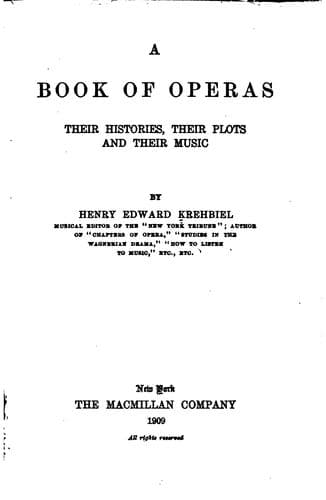
A Book of Operas: Their Histories, Their Plots, and Their MusicKrehbiel, Henry Edward
History
A Book of Operas: Their Histories, Their Plots, and Their Music
Krehbiel, Henry Edward
Operas -- Stories, plots, etc.
Oh, the heart-hunger of the hero! The longing! Will she never come?
The fever is consuming him, and his heated brain breeds fancies
which one moment lift him above all memories of pain and the next
bring him to the verge of madness. Cooling breezes waft him again
toward Ireland, whose princess healed the wound struck by Morold,
then ripped it up again with the avenging sword with its telltale
nick. From her hands he took the drink whose poison sears his heart.
Accursed the cup and accursed the hand that brewed it! Will the
shepherd never change his doleful strain? Ah, Isolde, how beautiful
you are! The ship, the ship! It must be in sight. Kurwenal, have
you no eyes? Isolde's ship! A merry tune bursts from the shepherd's
pipe:--
[Musical excerpt]
It is the ship! What flag flies at the peak? The flag of "All's
well!" Now the ship disappears behind a cliff. There the breakers
are treacherous. Who is at the helm? Friend or foe? Melot's
accomplice? Are you, too, a traitor, Kurwenal? Tristan's strength is
unequal to the excitement of the moment. His mind becomes dazed. He
hears Isolde's voice, and his wandering fancy transforms it into the
torch whose extinction once summoned him to her side: "Do I hear
the light?" He staggers to his feet and tears the bandages from his
wound. "Ha! my blood! flow merrily now! She who opened the wound is
here to heal it!" Life endures but for one embrace, one glance, one
word: "Isolde!" While Isolde lies mortally stricken upon Tristan's
corpse, Marke and his train arrive upon a second ship. Brangäne
has told the secret of the love-draught, and the king has come
to unite the lovers. But his purpose is not known, and faithful
Kurwenal receives his death-blow while trying to hold the castle
against Marke's men. He dies at Tristan's side. Isolde, unconscious
of all these happenings, sings out her broken heart, and expires.
And ere her ear might hear, her heart had heard,
Nor sought she sign for witness of the word;
But came and stood above him, newly dead,
And felt his death upon her: and her head
Bowed, as to reach the spring that slakes all drouth;
And their four lips became one silent mouth. {2}
Footnotes:
{1} "Studies in the Wagnerian Drama," by H. E. Krehbiel.
{2} Swinburne, "Tristram of Lyonesse."
CHAPTER XIV
"PARSIFAL"
Public-domain text, read in full here on John Shaqi.
Reviews
Reviews
No reviews yet
Be the first to share your thoughts on this work.
Elsewhere in the archive
Join the Discussion
Join the discussion
Sign in to leave a comment or review.
Sign InorCreate an account