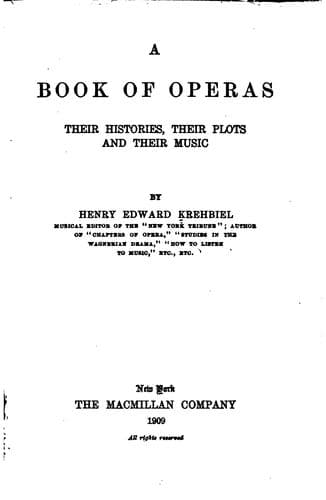
A Book of Operas: Their Histories, Their Plots, and Their MusicKrehbiel, Henry Edward
History
A Book of Operas: Their Histories, Their Plots, and Their Music
Krehbiel, Henry Edward
Operas -- Stories, plots, etc.
These are the folklore elements in Wagner's "Parsifal." It is plain
that they might have been wrought into a drama substantially like
that which was the poet-composer's last gift to art without loss
of either dignity or beauty. Then his drama would have been like
a glorified fairy play, imposing and of gracious loveliness, and
there would have been nothing to quarrel about. But Wagner was a
philosopher of a sort, and a sincere believer in the idea that the
theatre might be made to occupy the same place in the modern world
that it did in the classic. It was to replace the Church and teach
by direct preachments as well as allegory the philosophical notions
which he thought essential to the salvation of humanity. For the
chief of these he went to that system of philosophy which rests on
the idea that the world is to be redeemed by negation of the will to
live, the conquering of all desire--that the highest happiness is
the achievement of nirvana, nothingness. This conception finds its
highest expression in the quietism and indifferentism of the old
Brahmanic religion (if such it can be called), in which holiness
was to be obtained by speculative contemplation, which seems to me
the quintessence of selfishness. In the reformed Brahmanism called
Buddhism, there appeared along with the old principle of self-erasure
a compassionate sympathy for others. Asceticism was not put aside,
but regulated and ordered, wrought into a communal system. It was
purged of some of its selfishness by appreciation of the loveliness
of compassionate love as exemplified in the life of Çakya-Muni and
those labors which made him one of the many redeemers and saviours
of which Hindu literature is full. Something of this was evidently
in the mind of Wagner as long ago as 1857, when, working on "Tristan
und Isolde," he for a while harbored the idea of bringing Parzival
(as he would have called him then) into the presence of the
dying Tristan to comfort him with a sermon on the happiness of
renunciation. Long before Wagner had sketched a tragedy entitled
"Jesus of Nazareth," the hero of which was to be a human philosopher
who preached the saving grace of love and sought to redeem his time
and people from the domination of conventional law, the offspring
of selfishness. His philosophy was socialism imbued by love. Before
Wagner finished "Tristan und Isolde" he had outlined a Hindu play in
which hero and heroine were to accept the doctrines of the Buddha,
take the vow of chastity, renounce the union toward which love
impelled them, and enter into the holy community. Blending these two
schemes, Wagner created "Parsifal." For this drama he could draw
the principle of compassionate pity and fellow-suffering from the
stories of both Çakya-Muni and Jesus of Nazareth. But for the sake
of a spectacle, I think, he accepted the Christian doctrine of the
Atonement with all its mystical elements; for they alone put the
necessary symbolical significance into the principal apparatus of
Public-domain text, read in full here on John Shaqi.
Reviews
Reviews
No reviews yet
Be the first to share your thoughts on this work.
Elsewhere in the archive
Join the Discussion
Join the discussion
Sign in to leave a comment or review.
Sign InorCreate an account