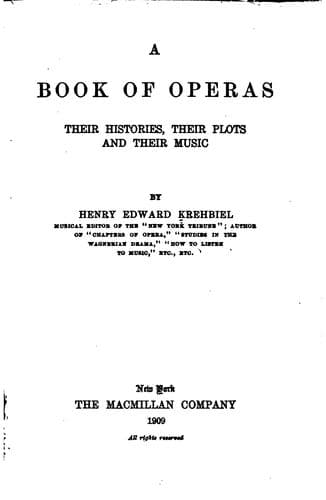
A Book of Operas: Their Histories, Their Plots, and Their MusicKrehbiel, Henry Edward
History
A Book of Operas: Their Histories, Their Plots, and Their Music
Krehbiel, Henry Edward
Operas -- Stories, plots, etc.
the play--the Holy Grail and the Sacred Lance. {1}
Footnotes:
{1} "Parsifal" was performed for the first time at the Wagner
Festival Theatre in Bayreuth on July 28, 1882. The prescription
that it should belong exclusively to Bayreuth was respected till
December 24, 1903, when Heinrich Conried, taking advantage of the
circumstance that there was no copyright on the stage representation
of the work in America, brought it out with sensational success at
the Metropolitan Opera-house in New York. The principal artists
concerned in this and subsequent performances were Milka Ternina
(Kundry), Alois Burgstaller (Paraifal), Anton Van Rooy (Amfortas),
Robert Blass (Gurnemanz), Otto Görlitz (Klingsor) and Louise Homer
(a voice).
CHAPTER XV
"DIE MEISTERSINGER VON NÜRNBERG"
The best definition of the true purpose of comedy which I know is
that it is to "chastise manners with a smile" (Ridendo castigat
mores); and it has no better exemplification in the literature
of opera than Wagner's "Die Meistersinger von Nürnberg." Wagner's
mind dwelt much on Greek things, and as he followed a classical
principle in choosing mythological and legendary subjects for his
tragedies, so also he followed classical precedent in drawing the
line between tragedy and comedy. "Tannhäuser," "Tristan und Isolde,"
"Der Ring des Nibelungen," "Parsifal," and, in a lesser degree,
"Lohengrin," are examples of the old tragedy type. To them the
restrictions of time and space do not apply. They deal with large
passions, and their heroes are gods or godlike men who are shattered
against the rock of immutable law--the "Fate" of the ancient
tragedians. His only significant essay in the field of comedy was
made in "Die Meistersinger," and this is as faithful to the old
conception of comedy as the dramas mentioned are to that of tragedy.
It deals with the manners, vices, and follies of the common people;
and, therefore, it has local environment and illustrates a period
in history. It was conceived as a satyr-play following a tragedy
("Tannhäuser"), and though there can be no doubt that it was
designed to teach a lesson in art, it nevertheless aims primarily
to amuse, and only secondarily to instruct and correct. Moreover,
even the most cutting of its satirical lashes are administered with
a smile.
Public-domain text, read in full here on John Shaqi.
Reviews
Reviews
No reviews yet
Be the first to share your thoughts on this work.
Elsewhere in the archive
Join the Discussion
Join the discussion
Sign in to leave a comment or review.
Sign InorCreate an account