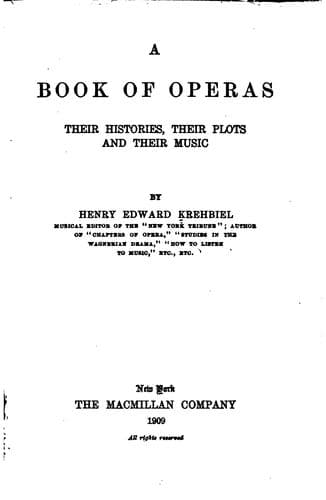
A Book of Operas: Their Histories, Their Plots, and Their MusicKrehbiel, Henry Edward
History
A Book of Operas: Their Histories, Their Plots, and Their Music
Krehbiel, Henry Edward
Operas -- Stories, plots, etc.
A desire to abstain as much as possible from criticism (that not
being the purpose of this book) led me to avoid mention of this
circumstance in the exposition of "Tannhäuser"; but I find that I
must now set it forth, though briefly. In the original form of the
opera there was no funeral procession and no death of the hero
beside the bier of the atoning saint. The scene between Tannhäuser
and Wolfram was interrupted by the tolling of a bell in the castle
to indicate the death of Elizabeth and the appearance of a glow of
rose-colored light across the valley to suggest the presence of
Venus. By bringing the corpse of Elizabeth on the stage so that
Tannhäuser might die by its side, Wagner was guilty of worse than an
anachronism. The time which elapses in the drama between Elizabeth's
departure from the scene and her return as a corpse is just as long
as the song which Wolfram sings in which he apostrophizes her as his
"holder Abendstern"--just as long and not a moment longer. There
is no question here of poetical license, for Wolfram sings the
apostrophe after her retreating figure, and the last chord of
his postlude is interrupted by Tannhäuser's words, "Ich hörte
Harfenschlag!" Yet we are asked to assume that in the brief interim
Elizabeth has ascended the mountain to the Wartburg, died, been
prepared for burial, and brought back to the valley as the central
object of a stately funeral.
It would have been much wiser to have left the death of Elizabeth
to the imagination of the public than to have made the scene
ridiculous. But Wagner was afraid to do that, lest his purpose be
overlooked. He was a master of theatrical craft, and though he could
write a tragedy like "Tristan und Isolde," with little regard for
external action, he was quite unwilling to miss so effective a
theatrical effect as the death of Tannhäuser beside Elizabeth's
bier. After all, he did not trust the public, whose judgment he
affected to place above that of his critics, and for this reason,
while he was willing to call up memories of his earlier opera by
quoting some of its music in "Parsifal," he ignored the question
which plays so important a rôle in "Lohengrin," and made the healing
of Amfortas depend upon a touch of the talismanic spear--a device
which came into the Grail story from pagan sources, as I have
already pointed out.
Now, why was the questioning of Lohengrin forbidden? Wolfram von
Eschenbach tells us, and his explanation sufficed Wagner when he
made his first studies of the Grail legends as a preparation for
"Lohengrin." It was the Holy Grail itself which pronounced the
taboo. An inscription appeared on the talisman one day commanding
that whenever a Knight of the Grail went into foreign lands to
assume rule over a people, he was to admonish them not to question
him concerning his name and race; should the question be put, he
was to leave them at once. And the reason?
Public-domain text, read in full here on John Shaqi.
Reviews
Reviews
No reviews yet
Be the first to share your thoughts on this work.
Elsewhere in the archive
Join the Discussion
Join the discussion
Sign in to leave a comment or review.
Sign InorCreate an account