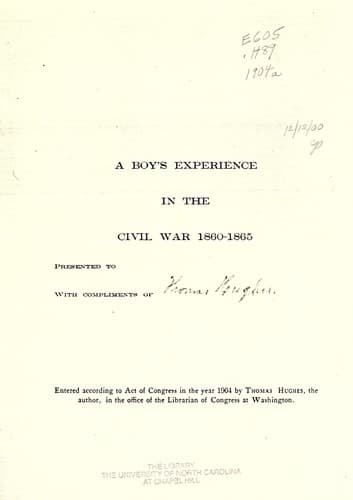
A Boy's Experience in the Civil War, 1860-1865 — John Shaqi
A Boy's Experience in the Civil War, 1860-1865Hughes, Thomas
History
A Boy's Experience in the Civil War, 1860-1865
Hughes, Thomas
United States -- History -- Civil War, 1861-1865 -- Personal narratives, Confederate
but one would find difficulty in discovering any thing in the incident
of the surrender other than those of a negative character calculated to
produce decided changes in an opinion preconceived of General Grant’s
character: and one’s opinions in matters of this sort are not usually
affected by negative influences. The views expressed by General Lee in
his letter were not those popularly accepted after the war as expressing
a high regard for General Grant, but were the views generally
entertained and expressed of General Grant by the Southern people in the
South during the war, except that General Lee was utterly incapable of
voicing the popular Southern expression wherein General Grant was styled
in the South during the war by the Southern press and by popular
expression there, horrible as it now sounds, a “butcher” in consequence
of the apparently heartless way in which he subjected great bodies of
his troops to what appeared useless loss of life.
In one of my interviews with Colonel Charles Marshall of Baltimore with
whom I enjoyed many years of intimate professional relation, I stated to
him what I have above referred to, mentioning the sentiments expressed
by General Lee in his letters to my father. Colonel Marshall who had
been General Lee’s private secretary during the war gave me to
understand that he knew they were the sentiments actually entertained.
Governor Letcher was the war governor of Virginia. Those who called upon
him were received in a room in the State House at one end of which stood
a large side board occupied by decanters and glasses, a part of his
Creed was to extend the hospitality of this side board to each visitor.
Virginia hospitality required him to keep company in the partaking of
the refreshments with the result that he had a phenomenally red face,
perpetually wreathed in smiles. It can be understood that delegations of
legislators often called upon him. He also frequently held evening
receptions that were exceedingly agreeable and very popular, although
never crowded and at one of these receptions which I attended I remember
viewing with astonishment, a portly man with long black curls hanging
down his back and with him an exceedingly pretty young girl whom I
learned was his daughter. This individual was well known in Richmond and
will be recognized without further description by any one conversant
with Richmond life during the war. At the time General Hunter burned the
Military Institute at Lexington he also burned Governor Letcher’s house
located there in revenge for which it will be remembered that Harry
Gilmor on his raid into Maryland burned the house of Governor Bradford
on Charles Street Avenue a few miles out from Baltimore. This same Harry
Gilmor possessed qualities of a superior character, for I remember that
after the war when he returned to Baltimore, with the occupation for
which nature fitted him as a soldier, gone, instead of his becoming a
Public-domain text, read in full here on John Shaqi.
Reviews
Reviews
No reviews yet
Be the first to share your thoughts on this work.
Join the Discussion
Join the discussion
Sign in to leave a comment or review.
Sign InorCreate an account