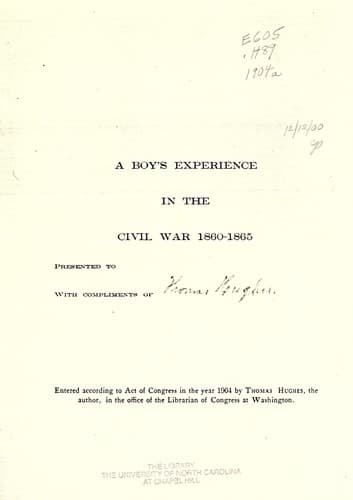
A Boy's Experience in the Civil War, 1860-1865Hughes, Thomas
History
A Boy's Experience in the Civil War, 1860-1865
Hughes, Thomas
United States -- History -- Civil War, 1861-1865 -- Personal narratives, Confederate
stipendiary on the bounty of his friends, he engaged for a while as a
journeyman painter, although no one had been raised with better rights
to gentle associations and I once viewed him with intense interest
painting the front of a house on the west side of Eutaw street near
Franklin and he was doing his work earnestly and well. With a slight
natural defect in one of his eyes, his face was entirely oblivious to
the fact of anything unusual in his occupation, a spirit of independence
that soon after led to his being elected sheriff of the City. This same
position of sheriff was also held by another returned Southerner who had
gone to Richmond from Baltimore where he had been Marshal of Police
shortly after we had passed through on our way to Richmond. This genial
gentleman, George P. Kane, showed in every trait and manner his racial
extraction and it was no matter of wonder that he passed from sheriff to
Mayor of the City.
When the Virginia Military Institute was burned after the battle of New
Market where the cadets lost a number who were killed and where many
were wounded, the corps was sent to Richmond. Every Richmond boy had a
great ambition to go to the Institute, at that time regarded as the West
Point of the South. The cadets were a part of the Confederate army and
every graduate was given an officer’s commission in the army. Incidents
were constantly occurring to keep alive and active this spirit to become
a cadet—boys have little fear of bullets, they enjoy the excitement of
active army life and even death and wounds appeal to them as making
heroes. After the battle of New Market one of the cadets a son of Dr.
Cabell of Richmond who was killed in that battle was brought to Richmond
for burial and his funeral took place from his father’s home on Franklin
street where he lived, a neighbor of General Lee. I remember as the
remains after the service were borne down the front steps and through
the iron front gate the intense awe and respect in the face of the young
men assembled on the pavement around the entrance to the open space in
front of the house. It was here I believe I first formed the
determination to be a cadet and, strange to say, when I first entered
the cadet ranks, the drill master assigned to our squad was Bob Cabell,
a brother of the cadet whose funeral I had attended that day.
Public-domain text, read in full here on John Shaqi.
Reviews
Reviews
No reviews yet
Be the first to share your thoughts on this work.
Join the Discussion
Join the discussion
Sign in to leave a comment or review.
Sign InorCreate an account