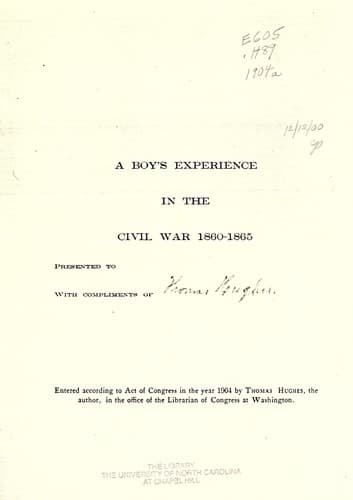
A Boy's Experience in the Civil War, 1860-1865Hughes, Thomas
History
A Boy's Experience in the Civil War, 1860-1865
Hughes, Thomas
United States -- History -- Civil War, 1861-1865 -- Personal narratives, Confederate
Thereupon he was dubbed a “rat”, which name he bore for one year. He was
liable to have trouble for the whole first year and might have to take
another bucking or stand up to a fight, which usually was brought about
in a formal way and was a great affair. The corporal of our room was a
mild mannered gentlemanly fellow named Bayard of Georgia, whose father
was, I believe, in the Confederate Congress from that State. After
bucking me and permitting me to choose Asa for my middle name he dubbed
me “mouse” and stated to me that if any one attempted to give me any
trouble to let him know. No trouble was there though for me, it was one
constant stretch of delightful experiences. The association with older
boys and men who treated me not simply as an equal but from my youth and
boyishness showed me every favor rendered my life one of joyous ease. I
was informed by the cadet whose name immediately preceded mine in roll
call of my company that any time I wanted to get off to let him know and
he would answer twice, once for himself, once for me. I was introduced
by a friendly cadet to the apothecary’s assistant who turned an honest
dollar in selling surreptitiously to the boys ginger cakes and pies at a
thousand per cent profit. I was recommended to old “Judge”, the negro
head cook and steward, who, black as coal, was with the boys the most
popular person in the corps, but for his favors which usually comprised
an extra allowance of bread, expected a suitable remembrance. A room I
have here described could furnish no more than living quarters for the
number occupying it, and how any studying could be done at night by two
dull tallow candles, the only lights was inexplicable. Toilets were
performed in a general wash room, adjoining a larger room where all
trunks were kept and these two rooms were on the same stoop or porch and
a little apart from the living rooms that all adjoined. If meagre fare
contributed to good health, the boys were entitled to the extraordinary
health they possessed with such surroundings. A typical breakfast was
“growley”, bread and Confederate coffee. Sometimes sorghum molasses took
the place of “growley.” This latter dish was quite watery, being a hash
of beef, potatoes and onions. A typical dinner was boiled Irish
potatoes, boiled corned beef and bread. Meals were served in the large
dining room in the basement at plain pine tables with no covering, each
table seating about one dozen. At the head of the table stood the large
dish of growley or the corn-beef and at each cadet’s plate was his half
loaf of bread. It required practice and expertness to slide one’s tin
plate over the table, to the “growley” dish for a helping and some art
to secure at long distance the favorable disposition of the cadet
sitting at the head to whom fell the delightful emolument of
apportioning the “growley.” The half loaf of bread was where old “Judge”
came in, for you always felt as if you wanted more. Each cadet was
Public-domain text, read in full here on John Shaqi.
Reviews
Reviews
No reviews yet
Be the first to share your thoughts on this work.
Join the Discussion
Join the discussion
Sign in to leave a comment or review.
Sign InorCreate an account