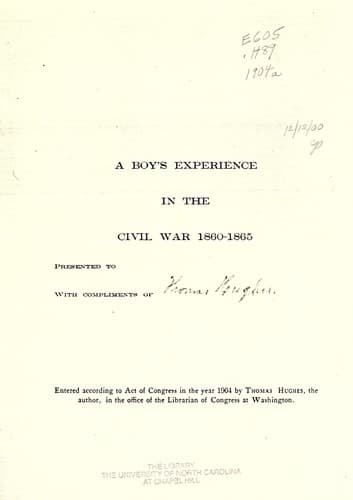
A Boy's Experience in the Civil War, 1860-1865Hughes, Thomas
History
A Boy's Experience in the Civil War, 1860-1865
Hughes, Thomas
United States -- History -- Civil War, 1861-1865 -- Personal narratives, Confederate
Blockade running was carried on as an extensive business all through the
war, but reached its highest state of accomplishment in the closing year
before the fall of Richmond. It was of a two fold character; one, of
ships with Wilmington, North Carolina, as the port and the other of
individuals who crossed the Potomac at night usually landing at
Leonardtown, Charles County, Maryland. The ships took out cargoes of
cotton, as this was about the only article, unless it was tobacco, left
to be exported from the Southern Confederacy and they brought in return
a miscellaneous cargo, not very extensive and not very large, most of
the cotton shipments winding up as credits abroad in many cases for
agents of the Confederate government, in other cases for individuals,
either singly or as syndicates. For it became common in Richmond for a
number of gentlemen to form a combination and make a shipment of cotton
by a blockade runner for the profit it furnished. Almost all the ships
that ran the blockade in and out of Wilmington flew the British flag and
were English boats. Blockade running on the Potomac was another
consideration. Its ordeal can best be illustrated by an attempt made by
my mother and a friend of hers under unusual favorable circumstances.
The trip from Richmond to the Potomac had to be made by private
conveyance of some sort for there were no public vehicles or way of
getting them and for entertainment en route reliance would have to be
placed on such friendly housing and entertainment as could be secured
from the inhabitants of the country through which one passed. There were
no hotels or taverns, and as the inhabitants were not over well
supplied, were in constant apprehension of the questionable strangers
who made a business of blockade running, it can be conceived what
difficulties must be encountered by any one who adopted this method of
passing through the lines. It would have been easier perhaps to have
gone by a flag of truce. A well known Southerner who is now in a
prominent position in New York City had attention attracted to him by
two occurrences that took place in his younger days. He was a general in
the Confederate army and he resigned and joined the army as a private,
that was quite sensational. Again he went out one day in front of the
outer line of breastworks near Petersburg to exchange newspapers or some
other thing as was the custom during the interims of fighting and two
soldiers from the Union lines came out half way to meet him. When they
reached midway between the breastworks on each side each Union soldier
took him by the arms and marched him into their own lines. That was more
sensational still and was susceptible of several constructions. The
incident subjected him to undoubtedly unjust criticism and the true
construction was that the Union soldiers had violated the conventional
arrangement under which the belligerents exchanged small articles, but
Public-domain text, read in full here on John Shaqi.
Reviews
Reviews
No reviews yet
Be the first to share your thoughts on this work.
Join the Discussion
Join the discussion
Sign in to leave a comment or review.
Sign InorCreate an account