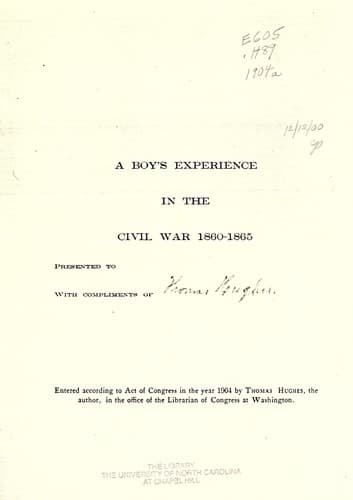
A Boy's Experience in the Civil War, 1860-1865 — John Shaqi
A Boy's Experience in the Civil War, 1860-1865Hughes, Thomas
History
A Boy's Experience in the Civil War, 1860-1865
Hughes, Thomas
United States -- History -- Civil War, 1861-1865 -- Personal narratives, Confederate
it indicated that the Union side were not averse to “receiving” all that
came and that going by flag of truce would have been less difficult on
the Union side than on the Confederate and that persons on a peaceful
mission, particularly ladies need not have selected the hardships of a
Potomac blockade running to have gotten through the lines.
My two sisters had been left North to attend school on my father’s
exchange as a state prisoner and my mother’s mission was to visit them.
My father’s official and professional relations secured for the trip
from the Confederate government a covered ambulance, two mules and a
colored driver. They were also supplied by personal friends with letters
of introduction to persons at whose houses they expected to stop on the
route to the Potomac. The trip was to occupy about three days and the
point of destination was as usual opposite Leonardtown, Charles County,
Maryland. The first day was spent in a tiring, uninteresting ride over
bad roads and the day’s journey terminated at the hospitable house of
Muscoe Garnett near Newton in King and Queen County at whose house I
subsequently spent a delightful summer, the next day’s journey similar
in character terminated at the equally hospitable home of the Warings on
the Rappahannock River in Essex County, where I also some years after
visited. The third day’s journey, just like the two proceeding, brought
them to the Potomac in Westmoreland County at the Wirt House. The
following day arrangements were made for effecting a crossing of the
river and this was termed “running the blockade.” Success required the
trip to be at night, without moon or stars, with good weather and smooth
water, a rather difficult combination where the river was several miles
wide and Union patrol boats constantly on the lookout for blockade
runners. At the appointed time, with conditions satisfactory, their boat
cleared the shore, when suddenly the moon came out, a patrol boat was
made out in the distance and the sail boat was compelled in consequence
to return, with no further chance of success that night. After several
days of waiting and constant unwillingness on the part of the boatman to
make the venture, in which at every attempt, he ran the risk of losing
both his boat and his liberty, they were fain to abandon the attempt,
this being a common experience in blockade running. And they were
compelled to return again to Richmond. Successful blockade running
across the Potomac was usually done by two only, the boatman and one
passenger, usually a man, a woman blockade runner added to the
difficulties and lessened a successful issue. Two women would constitute
almost insuperable difficulties and it had better been left unattempted.
It was easier to go by ship from Wilmington to Nassau, the usual
rendezvous of blockade runners and then from that point by a ship to New
York; for blockade running in and out of Wilmington was common and easy.
Public-domain text, read in full here on John Shaqi.
Reviews
Reviews
No reviews yet
Be the first to share your thoughts on this work.
Join the Discussion
Join the discussion
Sign in to leave a comment or review.
Sign InorCreate an account