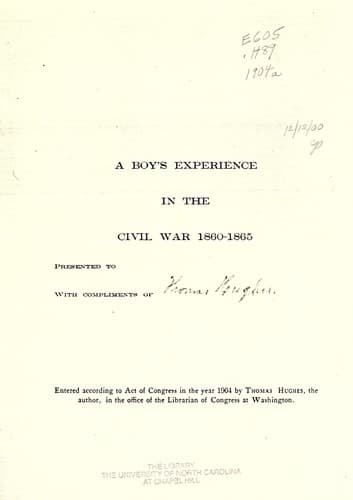
A Boy's Experience in the Civil War, 1860-1865Hughes, Thomas
History
A Boy's Experience in the Civil War, 1860-1865
Hughes, Thomas
United States -- History -- Civil War, 1861-1865 -- Personal narratives, Confederate
One of the most disastrous results of the war was the effect on the
education of the men of the South. With few exceptions all the young men
at college or school old enough to volunteer did so, with the resulting
loss of four years of the best period of their life for studying. At the
close of the war, the necessities of some were such that providing for
themselves or their families effectually removed from them the
possibilities of further education. Others again struggled under most
adverse conditions and with many privations to acquire the requisite
means to complete their education, working on farms and engaging in
manual labor that always theretofore had been relegated exclusively to
the negro slaves. In many cases the period for accomplishing the result
dragged on for years after the close of the war and even as late as
1871, six years after the close of the war there was in the same law
class with me at the University of Virginia, a number of ex-Confederate
soldiers and among the nineteen of us who received the degree of B. L.
were two, one of whom had been a Captain and the other a Major in the
Confederate army.
The condition of the ex-Confederates residing in the country was
measurably better than those in the cities and towns, for the former
could at the least scrape together in one way or another some sort of a
living. In the towns and cities however through the South the struggle
to obtain a footing was more intense, and among the methods adopted to
furnish employment to ex-Confederates was one of almost national
character involving what was then regarded as a very large capital with
prospects supposed to be brilliant both in furnishing extensive
employment for competent men and securing great financial returns for
its promoters and subscribers, and that was the establishment of the
Southern Express Company. General Joseph E. Johnson was made president
of the company and almost every officer and employee from the highest to
the lowest was an ex-Confederate soldier. These two pleas, employment of
ex-Confederates and great financial returns, particularly the former
were the basis upon which the subscriptions to the stock were generally
secured. An additional incentive was that only a small cash payment
(usually ten per cent of the subscription) was required from the
stockholders. The balance it was supposed would likely be made up from
profits. From the start liberal salaries were paid and assiduously
drawn. Nearly all the transportation business was done on credit, the
railroads and transportation companies being exceedingly liberal in
this, with the rapid result from inexperience in such business and
competition against an old established company and its skilled
employees, that the Southern Express Company soon ceased to do business,
owing a vast amount of debts to its employees for unpaid salaries and to
transportation companies for unpaid freight. The sequel resulted in an
Public-domain text, read in full here on John Shaqi.
Reviews
Reviews
No reviews yet
Be the first to share your thoughts on this work.
Join the Discussion
Join the discussion
Sign in to leave a comment or review.
Sign InorCreate an account