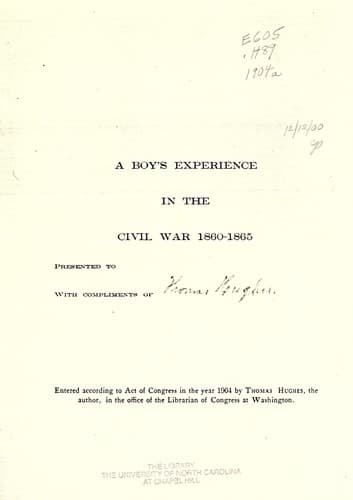
A Boy's Experience in the Civil War, 1860-1865Hughes, Thomas
History
A Boy's Experience in the Civil War, 1860-1865
Hughes, Thomas
United States -- History -- Civil War, 1861-1865 -- Personal narratives, Confederate
assignment by the company for the benefit of creditors and an
administration of its assets in the Chancery Court of Richmond, where
the stockholders were assessed their unpaid subscriptions, resulting in
a crop of suits to collect them that extended through many states of the
Union, particularly Virginia, Maryland, Missouri and New York.
The war had a very slight effect on the negro’s character as a slave in
the South, so far as he was capable of comprehending and entertaining
any sympathies, most of the slaves had a vague idea that success to the
Union Army meant freedom for the slave and hence naturally they felt no
ill toward this result, neither did they entertain ill will towards
those who had held them in slavery, for contrary to the general
impression of the North the negro slaves were treated with the greatest
consideration, not harshly, but just the reverse. Any master who omitted
to properly clothe and feed his slaves, to assiduously care for them in
sickness and old age and to treat them justly and humanely was not only
ostracised by his neighbors and acquaintances but his family suffered
seriously in social position so that no slaveholder was to be found who
could weather the trials to which an acknowledged brutal master was
subjected. This tenderness for the slave was so pronounced that all
persons who occupied a dominant position with reference to him, such as
the overseer or slave dealer were regarded as occupying an inferior
position and were excluded from social relations with the slave holders,
not from an imagined superiority of the latter, as sometimes alleged,
but purely from the “offensiveness” of their occupation. And I believe
it can be said with the endorsement of all who knew that the negro as a
whole was better cared for, and healthier and happier in slavery than in
freedom.
The hotels in Richmond that remained in operation clear up until the
evacuation by the Confederate troops were the Spotswood at the corner of
Main street and 8th street, the American on Main street opposite the
Post Office, and the Powhatan at the corner of Broad and 11th streets.
The Spottswood was the leading hotel and there the higher Confederate
officers stopped when in Richmond. It was burned shortly after the war
closed. The American was a popular hotel, well patronized by Confederate
soldiers, officers and men, and always crowded. It was burned in the
fire at the evacuation. The Powhatan was patronized to a certain extent
by Confederate soldiers, the generality of its patrons were members of
the Legislature.
Public-domain text, read in full here on John Shaqi.
Reviews
Reviews
No reviews yet
Be the first to share your thoughts on this work.
Join the Discussion
Join the discussion
Sign in to leave a comment or review.
Sign InorCreate an account