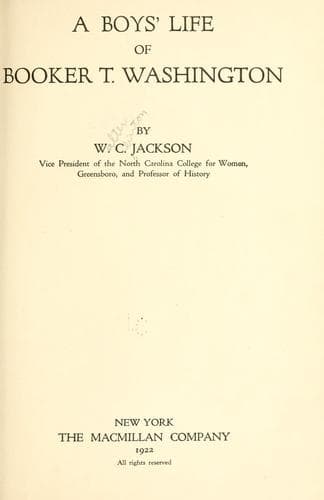
A boys' life of Booker T. WashingtonJackson, Walter Clinton
History
A boys' life of Booker T. Washington
Jackson, Walter Clinton
African American educators -- Biography -- Juvenile literature; Washington, Booker T., 1856-1915 -- Juvenile literature
As a result of his sweeping the room, he was permitted to enter his
classes and was also given a job as janitor, and his college career
began. It was a new, strange life. He sat down at a table, which had a
cloth on it, to eat his meals. He slept in a bed that had sheets on it.
These sheets gave him trouble. The first night he slept under both of
them. He didn’t think that was right, so the next night he slept on top
of both of them. The third night he watched his roommates,—there were
seven of them in the same room,—and he saw how the thing was done. After
that, he did as the others did and slept between the sheets.
“I sometimes feel,” he says, “that almost the most valuable lesson I got
at Hampton Institute was in the use and value of a bath. I learned
there, for the first time, some of its value was not only in keeping the
body healthy, but in inspiring selfrespect and promoting virtue. In all
my travels in the South and elsewhere since leaving Hampton Institute, I
have always in some way sought my daily bath. To get it sometimes when I
have been the guest of my own people in a single-roomed cabin has not
been easy to do except by slipping away to some stream in the woods. I
have always tried to teach my people that some provision for bathing
should be a part of every house.”[8]
For some time he had only one pair of socks. He had a time of it with
these socks. When they were too soiled to wear, he would wash them out
at night, hang them by the fire and dry them out, and put them on the
next morning. He also had a hard time with his clothes. They had
inspection every morning. The students were lined up, and General
Armstrong passed along the lines and carefully examined every one. If a
button was off, or if the clothes were torn or soiled in any way, the
General would see it. Booker had a hard time keeping his clothes in such
a condition that they would pass muster.
His work as janitor was very hard. He often had to work late at night,
for he had many rooms to clean. He always got up at four o’clock in the
morning to build his fires and do some of his studying. He had a hard
time working and making expenses too. He usually borrowed his books from
other students. He soon got some more clothing from the barrels of
clothing sent to the school by people from the North. Board was ten
dollars a month, part of which he could pay by his work as janitor, but
a part of it he was supposed to pay in cash, and he had no cash. His
work was so satisfactory, however, that in a short while he was told
that his work would pay all of his board. S. Griffitts Morgan, of New
Bedford, Massachusetts, paid his tuition. At the end of the year he owed
the college only sixteen dollars.
Public-domain text, read in full here on John Shaqi.
Reviews
Reviews
No reviews yet
Be the first to share your thoughts on this work.
Join the Discussion
Join the discussion
Sign in to leave a comment or review.
Sign InorCreate an account