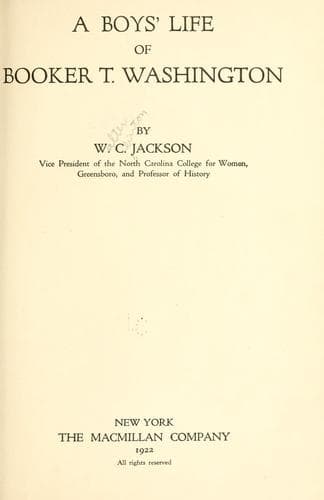
A boys' life of Booker T. WashingtonJackson, Walter Clinton
History
A boys' life of Booker T. Washington
Jackson, Walter Clinton
African American educators -- Biography -- Juvenile literature; Washington, Booker T., 1856-1915 -- Juvenile literature
There were many large gifts from many men and women, all of whom cannot
be mentioned here of course, but most of the money that was given to
Tuskegee came in small amounts from a large number of people,—from
churches, Sunday schools, missionary societies, and other organizations;
from preachers, teachers, lawyers, doctors, farmers—from every class of
people came gifts, sometimes large and sometimes small. All the
graduates of Tuskegee were loyal and gave something, however small the
amount might be. The Alabama Legislature gave more and more as the
school grew. The Slater Fund and the Peabody Fund also began to make
annual contributions to the school.
It was through all these channels that the money came pouring into
Tuskegee in such amounts that it was possible for it to grow and develop
in a remarkable way. Building after building went up. New students came.
New equipment was purchased. Additional faculty members were secured.
And the school grew in size and usefulness and in favor in the eyes of
the people.
CHAPTER X
MAKING SPEECHES
Frederick Douglass and Booker Washington rank as the greatest orators
the negro race has ever produced. This is a high place to occupy, for
the race has produced many remarkable speakers.
Douglass was the great spokesman for the race just before the Civil War
and during the troublesome days of reconstruction. Washington began his
career just at the time that Douglass ended his. Douglass was a very
eloquent man; perhaps more eloquent at times than Washington. On the
other hand, Washington was a better educated man than Douglass and
probably had a more lasting influence upon his generation.
Booker Washington made thousands of speeches in his life. He spoke to
white and black; in the North and in the South; in Europe as well as in
America. He spoke in churches; at school commencements; at conventions;
at educational and religious meetings; at county fairs; and to every
kind and condition of people. He spoke before kings and presidents; he
spoke to the lowliest men of his own race in the heart of the black belt
in Alabama. It is a wonderful thing to be an orator; to speak to men and
women in such a way that they will be helped and inspired and made
happier and more useful.
When Washington was at Hampton, he began to learn the art of speaking.
You remember how he organized a debating society which met for the
twenty minutes they had between supper and time to begin work. You
remember how he spoke and spoke at these meetings, doing his best to
learn how to express himself well. One of his teachers, Miss Mackie,
knew of his ambition to become a good speaker, and she gave him a great
deal of help, teaching him how to stand, how to pronounce his words, and
how to control his voice and gestures. By much hard work he came to be
the best speaker among the boys at Hampton.
Public-domain text, read in full here on John Shaqi.
Reviews
Reviews
No reviews yet
Be the first to share your thoughts on this work.
Join the Discussion
Join the discussion
Sign in to leave a comment or review.
Sign InorCreate an account