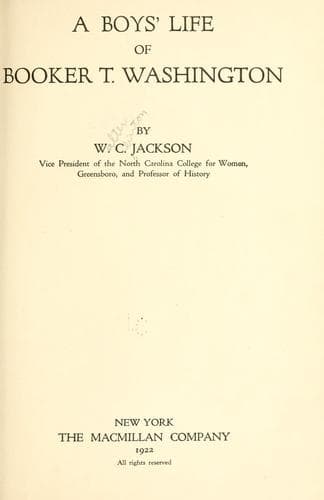
A boys' life of Booker T. WashingtonJackson, Walter Clinton
History
A boys' life of Booker T. Washington
Jackson, Walter Clinton
African American educators -- Biography -- Juvenile literature; Washington, Booker T., 1856-1915 -- Juvenile literature
You will recall, too, how General Armstrong invited him to deliver the
alumni address in 1879, and what a big success he made of that. All this
time he was speaking at Sunday schools, at churches, at educational
meetings, and everywhere he had an opportunity. His trip North with
General Armstrong gave him much valuable experience.
The first speech that he made that attracted the attention of all the
people was at the National Education Association, in Madison, Wis. The
most important thing he said in this speech was that the “whole future
of the negro rested largely upon the question as to whether or not he
should make himself, through his skill, intelligence, and character, of
such undeniable value to the community in which he lived that the
community could not dispense with his presence.” He said that any one
who “learned to do something better than anybody else—learned to do a
common thing in an uncommon manner—had solved his problem, regardless of
the color of his skin.”[18] He also said that the two races ought to be
brought closer together and cultivate the most cordial and friendly
relations, rather than become bitter toward each other.
But the greatest speech of Washington’s life was the Atlanta speech. In
the year 1895 the people of Georgia determined to hold a great Cotton
States Exposition, in Atlanta, which would set forth the progress of the
South since the Civil War. In order to make the exposition a great
success it was necessary to have the financial assistance of Congress.
So a committee was appointed to go to Washington to confer with a
committee from Congress. Booker Washington was appointed on this Georgia
committee; and his speech in Washington before the Congressional
committee was one of unusual force. Many said it was the best speech
made. Congress gave the assistance asked.
When the authorities came to plan the exposition in detail, they decided
to have a Negro Division. The negroes were asked to take part, and they
gladly agreed to do so. They built one of the best buildings on the
grounds. This building was planned by a negro architect and was erected
entirely by negro labor. It contained exhibits prepared altogether by
negroes. It was one of the most interesting parts of the entire
exposition.
When the exposition was formally opened in September, 1895, Booker
Washington was invited to make an address as a representative of the
negro race. James Creelman, a noted newspaper man, the correspondent of
the New York _World_, heard that speech, and he wrote to the _World_
about it. This is what he wrote:
Public-domain text, read in full here on John Shaqi.
Reviews
Reviews
No reviews yet
Be the first to share your thoughts on this work.
Join the Discussion
Join the discussion
Sign in to leave a comment or review.
Sign InorCreate an account