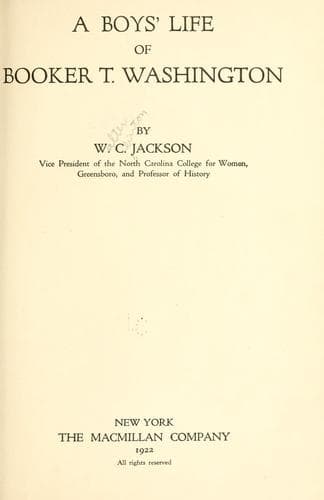
A boys' life of Booker T. WashingtonJackson, Walter Clinton
History
A boys' life of Booker T. Washington
Jackson, Walter Clinton
African American educators -- Biography -- Juvenile literature; Washington, Booker T., 1856-1915 -- Juvenile literature
By and by, when Booker was about nine years of age, there came a
thrilling day. For four long years the great war had been going on.
Often he had heard his mother singing freedom songs. He remembered being
awakened one morning and saw his mother by his bed and heard her praying
that Lincoln might be successful, and that her little boy might some day
be free. He had seen some of the soldiers in their uniforms, home on
furlough. He remembered when they brought home the body of “Marse Billy”
and buried him amidst the bitter weeping of the slaves, who loved him as
their friend, for he had often begged for them when they were about to
be punished. While they vaguely knew and felt that the success of
Lincoln meant freedom, and the success of the others meant slavery, they
were still loyal and true to their masters. By means of the “grape vine
telegraph,” that is, by passing news along quickly from one plantation
to another, the slaves had kept pretty well informed of the progress of
the war, and when Lee surrendered at Appomattox, the slaves knew it very
soon.
One night word came to the “quarters” that something very unusual would
happen at the “big house” the next day. There was much excitement.
Nobody slept that night. Early next morning some one came to the
quarters and told the negroes that they were all wanted at the house.
Booker’s mother called her children, and they with all the other slaves
marched up to the house. All the members of the family were on the
porch. They were very quiet and seemed sad and depressed. There was
present a stranger, a man who wore a uniform. He stood up and read a
paper—“The Emancipation Proclamation.” Then the master explained that
the negroes were now free. He told them that they could go wherever they
desired. He also told them that they could live where they were if they
wanted to, and they would be taken care of; but if they preferred, they
could go to any other place. Booker’s mother leaned over her children
and kissed them while the tears streamed down her face. Her prayers had
been answered. Her children were free.
CHAPTER II
BOYHOOD DAYS
When the slaves were set free, one of the first things that many of them
did was to change their names. Most of the slaves had only one name. As
free people they felt that they should have the same sort of names as
other free people; so they began to add a last name, and usually an
initial. If a man had been called “Tom” all his life, he was now called
“Tom L. Johnson.” The “L” stood for nothing. It was simply a part of his
“entitles,” as Washington says. Another thing they did was to leave
their old home place. They could not realize that they were really free
unless they tested the matter by going away from the place of their
servitude.
Public-domain text, read in full here on John Shaqi.
Reviews
Reviews
No reviews yet
Be the first to share your thoughts on this work.
Join the Discussion
Join the discussion
Sign in to leave a comment or review.
Sign InorCreate an account