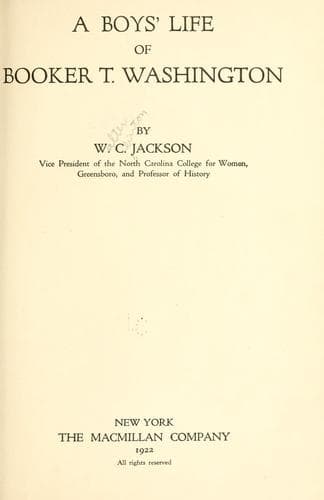
A boys' life of Booker T. WashingtonJackson, Walter Clinton
History
A boys' life of Booker T. Washington
Jackson, Walter Clinton
African American educators -- Biography -- Juvenile literature; Washington, Booker T., 1856-1915 -- Juvenile literature
Booker Washington’s stepfather had left Virginia during the war and had
gone to West Virginia. Just as soon as the war was over, he sent for his
wife and children to come to him in West Virginia.
He lived at Malden, five miles from Charleston, the capital of the
state. It was several hundred miles from the old home in Virginia, but
the family determined to go. They bundled up their goods and put them in
a cart, the children walking. They traveled the entire distance in this
way. They would stop by the roadside to do their cooking and to camp at
night.
One night they stopped near an empty cabin. They decided to spend the
night in the cabin. They went in and built a fire and spread a pallet on
the floor. Suddenly a big black snake rolled down out of the chimney and
on to the pallet. You can imagine that they did not care to stay longer
in that house. They got outside at once and made a camp.
After several weeks, they completed their journey, and the family
reached the town of Malden. Salt was mined there, and Booker’s
stepfather worked in the salt furnaces. Small as he was, Booker had to
begin this work too. It was very hard work, and it was terrible that
this child should be compelled to do it. But it was just like Booker to
turn the situation to an advantage. The first thing he ever did in the
way of reading was to learn the figure “18,” which was the number put on
the barrels of salt made by his father. Booker was anxious to learn to
read; but he had no one to teach him. His own mother could not even
teach him his letters. She bought him an old Webster’s “blue-back”
speller, and he began his first study in this book.
About this time a private school was established in the community.
Booker was greatly excited over this, for he had an overwhelming desire
to go to school. He was a good worker, however, and was earning money;
so his father said “no,” and he could not go. Booker was terribly
disappointed. He went on with his work with a heavy heart, but he never
missed a chance to urge his stepfather to let him go to school. Finally,
his father agreed to let him go for a part of the day, provided he would
get up early each morning and work until nine o’clock and then work two
hours after school was out.
It was a glorious day for him when he found himself going to school.
However, he soon encountered two great difficulties. One was that he did
not have a hat. He had never worn a hat or cap in his life. Since all
the other boys had them, he felt that he must have one. So he went home
and told his mother about the situation. She explained to him that she
had no money with which to buy a “store” hat, but she got two old pieces
of “homespun” or jeans, and sewed them together for a cap. The next day
Booker proudly walked to school with one difficulty solved.
Public-domain text, read in full here on John Shaqi.
Reviews
Reviews
No reviews yet
Be the first to share your thoughts on this work.
Join the Discussion
Join the discussion
Sign in to leave a comment or review.
Sign InorCreate an account