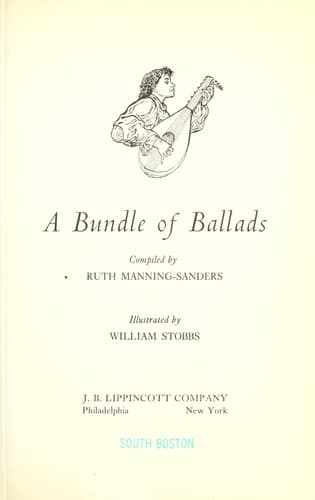
Ballads, English -- England -- Texts; Songs, English -- England -- Texts
Produced by Les Bowler
A BUNDLE OF BALLADS
Edited By Henry Morley
CONTENTS.
INTRODUCTION
CHEVY CHASE
CHEVY CHASE (the later version)
THE NUT-BROWN MAID
ADAM BELL, CLYM OF THE CLOUGH, AND WILLIAM OF CLOUDESLIE
BINNORIE
KING COPHETUA AND THE BEGGAR MAID
TAKE THY OLD CLOAK ABOUT THEE
WILLOW, WILLOW, WILLOW
THE LITTLE WEE MAN
THE SPANISH LADY'S LOVE
EDWARD, EDWARD
ROBIN HOOD
KING EDWARD IV. AND THE TANNER OF TAMWORTH
SIR PATRICK SPENS
EDOM O' GORDON
THE CHILDREN IN THE WOOD
THE BEGGAR'S DAUGHTER OF BETHNAL GREEN
THE BAILIFF'S DAUGHTER OF ISLINGTON
BARBARA ALLEN'S CRUELTY
SWEET WILLIAM'S GHOST
THE BRAES O' YARROW
KEMP OWYNE
O'ER THE WATER TO CHARLIE
ADMIRAL HOSIER'S GHOST
JEMMY DAWSON
WILLIAM AND MARGARET
ELFINLAND WOOD
CASABIANCA
AULD ROBIN GRAY
GLOSSARY
INTRODUCTION BY THE EDITOR.
Recitation with dramatic energy by men whose business it was to travel
from one great house to another and delight the people by the way,
was usual among us from the first. The scop invented and the glee-man
recited heroic legends and other tales to our Anglo-Saxon forefathers.
These were followed by the minstrels and other tellers of tales written
for the people. They frequented fairs and merrymakings, spreading the
knowledge not only of tales in prose or ballad form, but of appeals also
to public sympathy from social reformers.
As late as the year 1822, Allan Cunningham, in publishing a collection
of "Traditional Tales of the English and Scottish Peasantry," spoke from
his own recollection of itinerant story-tellers who were welcomed in the
houses of the peasantry and earned a living by their craft.
The earliest story-telling was in recitative. When the old alliteration
passed on into rhyme, and the crowd or rustic fiddle took the place of
the old "gleebeam" for accentuation of the measure and the meaning of
the song, we come to the ballad-singer as Philip Sidney knew him. Sidney
said, in his "Defence of Poesy," that he never heard the old song of
Percy and Douglas, that he found not his heart moved more than with a
trumpet; and yet, he said, "it is sung but by some blind crowder, with
no rougher voice than rude style; which being so evil apparelled in the
dust and cobweb of that uncivil age, what would it work trimmed in the
gorgeous eloquence of Pindar?" Many an old ballad, instinct with natural
feeling, has been more or less corrupted, by bad ear or memory, among
the people upon whose lips it has lived. It is to be considered,
however, that the old broader pronunciation of some letters developed
some syllables and the swiftness of speech slurred over others,
which will account for many an apparent halt in the music of what was
actually, on the lips of the ballad-singer, a good metrical line.
Public-domain text, read in full here on John Shaqi.
Reviews
Reviews
No reviews yet
Be the first to share your thoughts on this work.
Join the Discussion
Join the discussion
Sign in to leave a comment or review.
Sign InorCreate an account