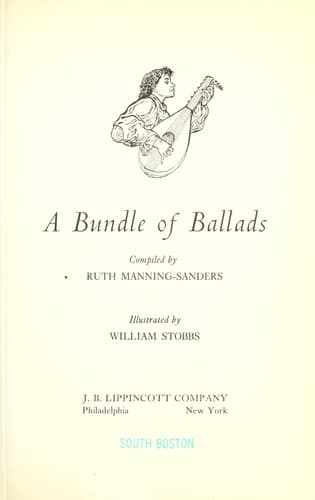
Ballads, English -- England -- Texts; Songs, English -- England -- Texts
"Chevy Chase" is, most likely, a corruption of the French word
chevauchee, which meant a dash over the border for destruction and
plunder within the English pale. Chevauchee was the French equivalent
to the Scottish border raid. Close relations between France and Scotland
arose out of their common interest in checking movements towards their
conquest by the kings of England, and many French words were used with a
homely turn in Scottish common speech. Even that national source of joy,
"great chieftain of the pudding-race," the haggis, has its name from
the French hachis. At the end of the old ballad of "Chevy Chase," which
reads the corrupted word into a new sense, as the Hunting on the Cheviot
Hills, there is an identifying of the Hunting of the Cheviot with the
Battle of Otterburn:--
"Old men that knowen the ground well enough call it the Battle of
Otterburn.
At Otterburn began this spurn upon a Monenday;
There was the doughty Douglas slain, the Percy never went away."
The Battle of Otterburn was fought on the 19th of August 1388. The
Scots were to muster at Jedburgh for a raid into England. The Earl
of Northumberland and his sons, learning the strength of the Scottish
gathering, resolved not to oppose it, but to make a counter raid into
Scotland. The Scots heard of this and divided their force. The
main body, under Archibald Douglas and others, rode for Carlisle.
A detachment of three or four hundred men-at-arms and two thousand
combatants, partly archers, rode for Newcastle and Durham, with James
Earl of Douglas for one of their leaders. These were already pillaging
and burning in Durham when the Earl of Northumberland first heard
of them, and sent against them his sons Henry and Ralph Percy. In a
hand-to-hand fight between Douglas and Henry Percy, Douglas took Percy's
pennon. At Otterburn the Scots overcame the English but Douglas fell,
struck by three spears at once, and Henry was captured in fight by Lord
Montgomery. There was a Scots ballad on the Battle of Otterburn quoted
in 1549 in a book--"The Complaynt of Scotland"--that also referred
to the Hunttis of Chevet. The older version of "Chevy Chase" is in an
Ashmole MS. in the Bodleian, from which it was first printed in 1719 by
Thomas Hearne in his edition of William of Newbury's History. Its author
turns the tables on the Scots with the suggestion of the comparative
wealth of England and Scotland in men of the stamp of Douglas and Percy.
The later version, which was once known more widely, is probably not
older than the time of James I., and is the version praised by Addison
in Nos. 70 and 74 of "The Spectator."
"The Nut-Brown Maid," in which we can hardly doubt that a woman pleads
for women, was first printed in 1502 in Richard Arnold's Chronicle.
Nut-brown was the old word for brunette. There was an old saying that "a
nut-brown girl is neat and blithe by nature."
Public-domain text, read in full here on John Shaqi.
Reviews
Reviews
No reviews yet
Be the first to share your thoughts on this work.
Join the Discussion
Join the discussion
Sign in to leave a comment or review.
Sign InorCreate an account