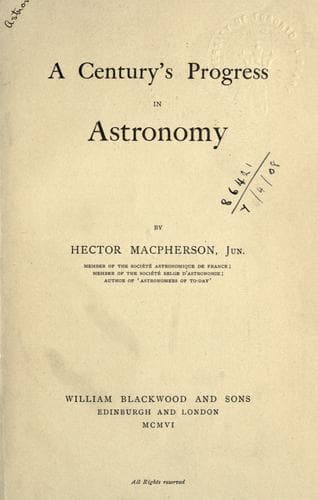
A Century's Progress in AstronomyMacpherson, Hector
History
A Century's Progress in Astronomy
Macpherson, Hector
Astronomy -- History
Honours were showered on Herschel. He was knighted in 1816, and became
President of the Royal Astronomical Society in 1820, besides receiving
several honorary degrees. But honours in no way elated him. Advancing
years in no way affected his wonderful mind. But his duties as King’s
Astronomer necessitated his acting as “showman of the heavens” on the
visits of royalties to Windsor, often after a whole day’s work, when
rest was absolutely necessary. This tremendous strain, which reflects
little credit on the Court, proved too much for the old man. His health
began to give way, although his mind was as vigorous as ever.
Herschel contributed his last paper to the Royal Society in 1818, and
three years later sent a list of double stars to the new Astronomical
Society. He made his last observation on June 1, 1821. His strength had
now left him, and to this he could not reconcile himself. As Miss Clerke
puts it, “All his old instincts were still alive, only the bodily power
to carry out their behests was gone. An unparalleled career of
achievement left him unsatisfied with what he had done.... His strong
nerves were at last shattered.” After a prolonged period of failing
health he died at Slough, at the age of eighty-three, on August 25,
1822. On September 7 he was buried in the church-yard of St Laurence at
Upton. On his tombstone are engraved the words—“Cœlorum perrupit
claustra”—he broke through the barriers of the skies.
The death of her brother was a terrible blow to Caroline Herschel.
Expecting to live only a twelvemonth, she returned to Hanover to the
home of her brother, Dietrich Herschel. But she lived twenty-five years
among people who cared nothing for astronomy. She was delighted at Sir
John Herschel’s continuation of his father’s work. She compiled a
catalogue of all the clusters and nebulæ observed by her brother, for
which she received the gold medal of the Astronomical Society, and she
was created an honorary member. In 1846 she received from the King of
Prussia the gold medal of science. But no honours made her in any way
elated. She always held that whoever said much of her said too little of
her brother. After a prolonged decline of health, she died on January 9,
1848, aged ninety-seven years, and was buried beside her father in the
churchyard of the Gartengemeinde at Hanover, leaving behind her a noble
example of self-sacrifice and devotion.
CHAPTER II.
HERSCHEL THE DISCOVERER.
Public-domain text, read in full here on John Shaqi.
Reviews
Reviews
No reviews yet
Be the first to share your thoughts on this work.
Join the Discussion
Join the discussion
Sign in to leave a comment or review.
Sign InorCreate an account