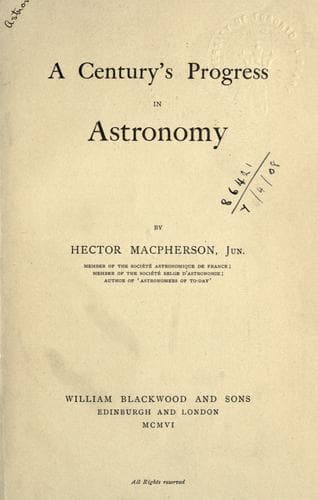
A Century's Progress in AstronomyMacpherson, Hector
History
A Century's Progress in Astronomy
Macpherson, Hector
Astronomy -- History
In 1775 he commenced his review of the heavens, but finding his
telescope inadequate he began the work of telescope-making afresh.
Meanwhile he had much to distract him from astronomy. In 1776 he became
director of the Public Concerts at Bath. Yet his enthusiasm was
unbounded: he would run to his house between the acts at the theatre to
observe the heavens. In 1779, when observing the Moon from the street in
front of his house, a gentleman asked permission to see the celestial
wonders, a request which Herschel granted. The gentleman, Dr Watson of
Bath, introduced Herschel to the Literary Society, and we find him in
1780 contributing two papers to the Royal Society on Mira Ceti and the
Moon. In the same year he commenced his second review of the heavens,
and during its progress he made his first great discovery. On March 13,
1781, while surveying the constellation Gemini, he discovered a faint
object distinguished by a disc, which he concluded to be a tailless
comet, but which was soon shown to be a new planet beyond the orbit of
Saturn. This was the first planetary discovery made within the memory of
man. King George III. summoned Herschel to London, and gave him a
pension of £200 a-year, with the title of King’s Astronomer, pardoning
him also for his desertion from the army more than twenty years
previously. Herschel then named the new planet the “Georgium Sidus,” a
title now abandoned and replaced by Uranus.
William and Caroline Herschel now moved to Datchet, near Windsor, in
1785 to Clay Hall, and finally, in 1786, to Slough,—“the spot of all the
world,” said Arago, “where the greatest number of discoveries have been
made.” Here Herschel and his sister worked for nearly forty years. He
communicated to the Royal Society paper after paper on astronomy in all
its aspects. He also continued the work of telescope-making, and
constructed, in 1789, his 40-foot reflector, the wonder of the age. In
1787 his sister was appointed his assistant, and together the Herschels
worked from dusk to dawn. Caroline Herschel herself detected eight
comets and numerous nebulæ. She relates in her memoirs that on one
occasion, while she was acting as assistant, the ink froze in her pen.
But such inconveniences mattered not to the Herschels. As Miss Clerke
has well remarked, “Every serene dark night was to him a precious
opportunity, availed of to the last minute. The thermometer might
descend below zero, ink might freeze, mirrors might crack; but, provided
the stars shone, he and his sister worked on from dusk to dawn.... On
one occasion he is said to have worked without intermission at the
telescope and the desk for seventy-two hours.”
Public-domain text, read in full here on John Shaqi.
Reviews
Reviews
No reviews yet
Be the first to share your thoughts on this work.
Join the Discussion
Join the discussion
Sign in to leave a comment or review.
Sign InorCreate an account