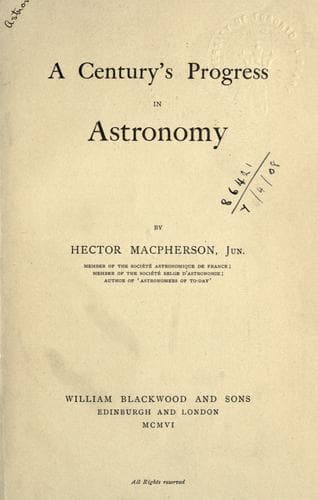
A Century's Progress in AstronomyMacpherson, Hector
History
A Century's Progress in Astronomy
Macpherson, Hector
Astronomy -- History
scattered through space with some approach to uniformity, Herschel was
able to compute the extent to which his telescope penetrated into space;
and, assuming that the Universe was finite and that his
“gauging-telescope” was sufficiently powerful to completely resolve the
Milky Way, he was enabled to sketch the shape and extent of the
Universe.
Thus Herschel concluded that the Universe extended in the direction of
the Galaxy to 850 times the mean distance of stars of the first
magnitude. In the direction of the galactic poles the thickness was only
155 times the distance of stars of the same magnitude. Herschel was thus
enabled to sketch the probable form of the Universe, which he regarded
as cloven at one of its extremities, the cleft being represented by the
famous gap in the Milky Way. The Universe was, in fact, supposed to be a
cloven disc, and the Milky Way was merely a vastly extended portion of
it and not a region of actual clustering. On this theory the clusters
and nebulæ were supposed to be galaxies external to the Universe. Even
in 1785, however, Herschel believed that there were regions in the Milky
Way where the stars were more closely clustered than others. “It would
not be difficult,” he wrote in 1785, “to point out two or three hundred
gathering clusters in our system.”
Strange to say, Herschel’s original ideas regarding the Universe were
accepted for many years by astronomical writers. Arago accepted
Herschel’s original theory, unaware that he had in reality abandoned it,
and he was followed by a host of French and English writers who did not
take the trouble to read each of Herschel’s papers, merely quoting that
of 1785, and believing that it represented his final ideas on the
subject. Even Sir John Herschel seems to have been unaware that his
father gave up the disc theory of the Universe. The famous German
astronomer, Wilhelm Struve, after an exhaustive study of Herschel’s
papers, was enabled to prove in 1847 that the theory had been abandoned
by Herschel; and in England the late R. A. Proctor independently
demonstrated the same thing. Meanwhile, supposing Herschel had not given
up his theory, it would be quite untenable. After considering the fact
that the brighter stars, down to the ninth magnitude, aggregate on the
Milky Way, Mr Gore says: “As the stars are by hypothesis supposed to be
uniformly distributed throughout every part of the disc, and as the
limiting circles for stars to the eighth and ninth magnitudes fall well
within the thickness of the disc, there is no reason why stars of these
magnitudes should not be quite as numerous in the direction of the
galactic poles as in that of the Milky Way itself. We see, therefore,
that the disc theory fails to represent the observed facts, and that
Struve and Proctor were amply justified in their opinion that the theory
is wholly untenable, and should be abandoned.”
Public-domain text, read in full here on John Shaqi.
Reviews
Reviews
No reviews yet
Be the first to share your thoughts on this work.
Join the Discussion
Join the discussion
Sign in to leave a comment or review.
Sign InorCreate an account