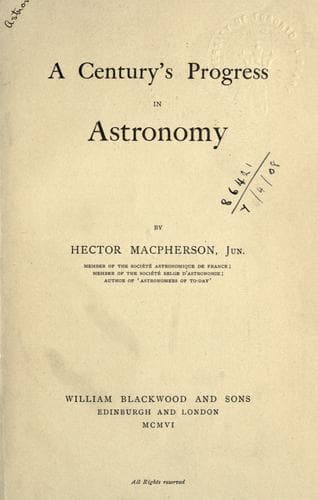
A Century's Progress in AstronomyMacpherson, Hector
History
A Century's Progress in Astronomy
Macpherson, Hector
Astronomy -- History
The observations made by Herschel himself eventually proved fatal to the
disc theory—a hypothesis which he had all along held very lightly. His
ideas about subordinate clusters within the Milky Way were soon
confirmed, and though in 1799 he still adhered to the disc theory, he
wrote in 1802, “I am now convinced, by a long inspection and continued
examination of it, that the Milky Way itself consists of stars very
differently scattered from those which are immediately about us. This
immense starry aggregation is by no means uniform. The stars of which it
is composed are very unequally scattered”—a conclusion quite opposed to
the disc theory, where the Milky Way was supposed to be merely an
extended portion of the Universe.
In 1811 Herschel wrote as follows: “I must freely confess that by
continuing my sweeps of the heavens, my opinion of the arrangement of
the stars, and their magnitudes, and some other particulars, has
undergone a gradual change; and, indeed, when the novelty of the subject
is considered we cannot be surprised that many things formerly taken for
granted should on examination prove to be different from what they were
generally but incautiously supposed to be. For instance, an equal
scattering of the stars may be admitted in certain calculations; but
when we examine the Milky Way, or the closely compressed clusters of
stars, of which my catalogues have recorded so many instances, this
supposed equality of scattering must be given up.”
This was the virtual abandonment of the disc theory. Six years later
Herschel announced that in six cases he had failed to resolve the Milky
Way, stating that his telescopes could not fathom it. This was the
abandonment of his second assumption—namely, that his telescope was
sufficiently powerful to penetrate to the limits of the Universe. Yet he
still thought that some of the star-clusters might be external galaxies,
although he could not even dogmatically assert our Universe to be
limited. In an error of translation, Struve left the impression that
Herschel believed our Universe to be unfathomable or infinite, and was
obliged to devise a most artificial theory of the extinction of light to
account for the fact that the sky did not shine with the brilliance of
the Sun, which it would do were the stars infinite in number. Of course,
Herschel did not actually believe the Universe to be infinite, and, had
he lived, he would probably have shown that all the star-clusters which
we see are included within the bounds of our finite Galaxy.
Public-domain text, read in full here on John Shaqi.
Reviews
Reviews
No reviews yet
Be the first to share your thoughts on this work.
Join the Discussion
Join the discussion
Sign in to leave a comment or review.
Sign InorCreate an account