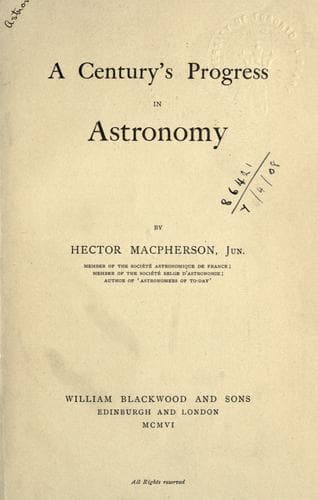
A Century's Progress in AstronomyMacpherson, Hector
History
A Century's Progress in Astronomy
Macpherson, Hector
Astronomy -- History
In 1814 Herschel was “still engaged in a series of observations for
ascertaining a scale whereby the extent of the Universe, as far as it is
possible for us to penetrate into space, may be fathomed.” In 1817 he
described another method of star-gauging, which Arago and other writers
have confused with that which he devised in 1785. The two methods,
however, were quite distinct from each other. In the first system, one
telescope was used on different regions of the heavens; whereas in the
second method, various telescopes were used on identical regions. The
principle was that the telescopic power necessary to resolve groups of
stars indicates the distance at which the stars of the groups lie. This,
however, also assumed an equal distribution of stars, and as the late Mr
Proctor says, “I conceive that no question can exist that the principle
is unsound, and that Herschel would himself have abandoned it had he
tested it earlier in his observing career.... In applying it, Sir W.
Herschel found regions of the heavens very limited in extent, where the
brighter stars (clustered like the fainter) were easily resolved with
low powers, but where his largest telescopes could not resolve the
faintest. These regions, if the principle were true, must be long,
spike-shaped star groups, whose length is directed exactly towards the
astronomer on Earth,—an utterly incredible arrangement.”
Herschel, at the time of his death, left unsolved the problem of the
construction of the heavens. It is still unsolved, and will doubtless
remain so until astronomers know more about the distances and motions of
the stars. His last observation of the Galaxy showed that even with his
40-foot reflector he could not fathom it. Consequently, as we have
mentioned, Struve and his successors regarded the Universe as infinite—a
theory which has now received its death-blow. Herschel was undoubtedly
correct when he stated his belief in a limited Universe.
Herschel’s star-gauges, and those of his son, still remain of immense
value to astronomers in any discussion of the construction of the
heavens. Thus, although they failed to reveal to Herschel the structure
of the Universe, they have been of much use to his successors.
Herschel’s discussion of the supreme problem—the ultimate object of his
observations—constitutes one of the most interesting chapters in the
history of science, and marks a new era in human thought. In the words
of Miss Clerke: “One cannot reflect without amazement that the special
life-task set himself by this struggling musician—originally a penniless
deserter from the Hanoverian Guard—was nothing less than to search out
the ‘construction of the heavens.’ He did not accomplish it, for that
was impossible; but he never relinquished, and, in grappling with it,
laid deep and sure the foundations of sidereal science.”
CHAPTER III.
THE SUN.
Public-domain text, read in full here on John Shaqi.
Reviews
Reviews
No reviews yet
Be the first to share your thoughts on this work.
Join the Discussion
Join the discussion
Sign in to leave a comment or review.
Sign InorCreate an account