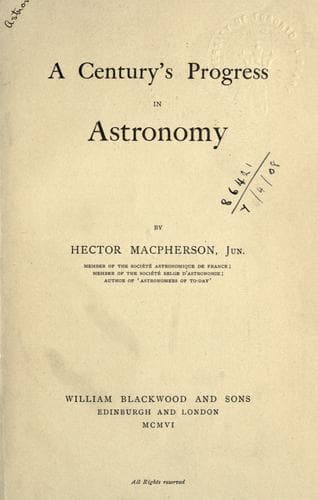
A Century's Progress in AstronomyMacpherson, Hector
History
A Century's Progress in Astronomy
Macpherson, Hector
Astronomy -- History
The last of the solar appendages, the corona, can only be seen during
total eclipses. The researches of Young and Janssen indicate that it is
partly gaseous and partly meteoric in its constitution; and various
photographs, taken at the eclipses since 1870, have demonstrated its
variation in shape, which is in harmony with the eleven-year period.
Several attempts have been made to observe the corona without an
eclipse. In 1882 Huggins made the attempt, but failed, and Hale, with
his photographic process, had no better success. More recently, in 1904,
a Russian astronomer, _Alexis Hansky_, observing from the top of Mont
Blanc, secured some photographs on which he believes the corona is
represented, but so far his observations have not been confirmed by
other astronomers.
The application of the spectroscope to the motions on the solar surface
is perhaps one of the most wonderful triumphs in astronomical science.
In 1842 _Christian Doppler_ (1803-1853), Professor of Mathematics at
Prague, had expressed the view that the colour of a luminous body must
be changed by its motion of approach or recession. It was obvious to
Doppler that if the body was approaching, a larger number of light waves
must be entering the eye of the observer than if it were retreating.
Miss Clerke thus illustrates Doppler’s principle: “Suppose shots to be
fired at a target at fixed intervals of time. If the marksman advances,
say, twenty paces between each discharge of his rifle, it is evident
that the shots will fall faster on the target than if he stood still;
if, on the contrary, he retires by the same amount, they will strike at
correspondingly longer intervals.” It occurred to various astronomers
that it would be possible to measure cyclones and hurricanes in the Sun,
not by change of colour in the spectrum, but by the shifting of the
lines; and in 1870 this was successfully done by Lockyer. In the next
few years efforts to measure the solar rotation were made by Young,
Zöllner, and others, who succeeded in measuring the displacement of the
lines, but not the time of rotation. This was reserved for the famous
Swedish astronomer, Dunér.
_Nils Christopher Dunér_, born in 1839 in Scania, was employed as an
assistant at Lund Observatory from 1858 to 1888, when he was appointed
director of the Observatory at Upsala. In that year he commenced a study
of the solar rotation, measuring it by means of Doppler’s principle. He
confirmed the telescopic work of Carrington and Spörer on the equatorial
acceleration, and measured the displacement up to within fifteen degrees
of the poles. He brought out the surprising fact that the rotation
period of the Sun is there protracted to 38½ days. These remarkable
researches were published in 1891.
Public-domain text, read in full here on John Shaqi.
Reviews
Reviews
No reviews yet
Be the first to share your thoughts on this work.
Join the Discussion
Join the discussion
Sign in to leave a comment or review.
Sign InorCreate an account