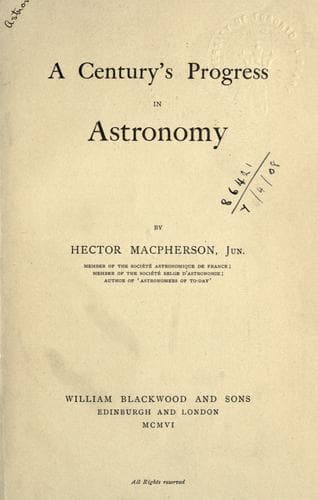
A Century's Progress in AstronomyMacpherson, Hector
History
A Century's Progress in Astronomy
Macpherson, Hector
Astronomy -- History
In 1873 the Astronomer-Royal of England commenced at Greenwich
Observatory to photograph the Sun daily. This work has been carried on
there by _Edward Walter Maunder_ (born 1851), and Greenwich Observatory
possesses a photographic record of sun-spots. At the Meudon
Astrophysical Observatory, near Paris, Janssen has, since 1876, secured
photographs of the solar surface, which were comprised in a great atlas,
published by him in January 1904. These photographs have revealed a
remarkable phenomenon—the “réseau photospherique,” the distribution over
the solar surface of blurred patches of light, which Janssen considers
are inherent in the Sun. The Greenwich records of sun-spots and of
magnetic disturbances have been made use of by Maunder in his remarkable
studies, promulgated in 1904, of the connection between sun-spots and
terrestrial magnetism. Maunder finds that on the average magnetic storms
are dependent on the presence of sun-spots, and on the size of the spot.
The magnetic action, he finds, does not radiate equally in all
directions from the sun-spots, but along definite and restricted lines.
Herschel’s hypothesis of a dark and cool globe beneath the solar
photosphere was seen to be untenable after the introduction of the
spectroscope. The first important theory as to the solar constitution
was that advanced in 1865 by the French astronomer, _Hervé Faye_
(1814-1902). Numerous other theories were afterwards advanced by Secchi,
Zöllner, Young, and others, but a complete description of the various
developments in solar theorising cannot be given here. There is no
complete “theory” of the exact constitution of every part of the Sun,
but the unpretentious “Views of Professor Young on the Constitution of
the Sun,” which appeared in April 1904 in ‘Popular Astronomy,’ represent
the latest ideas of the foremost solar investigator. Professor Young
regards the reversing layer and the chromosphere as “simply the
uncondensed vapours and gases which form the atmosphere in which the
clouds of the photosphere are suspended.” He says that the contraction
theory of Helmholtz,—explained in another chapter,—advanced to explain
the maintenance of the Sun’s heat, is true so far as it goes; but that
it is all the truth is now made doubtful by the discovery of radium,
which “suggests that other powerful sources of energy may co-operate
with the mechanical in maintaining the Sun’s heat.”
Public-domain text, read in full here on John Shaqi.
Reviews
Reviews
No reviews yet
Be the first to share your thoughts on this work.
Join the Discussion
Join the discussion
Sign in to leave a comment or review.
Sign InorCreate an account