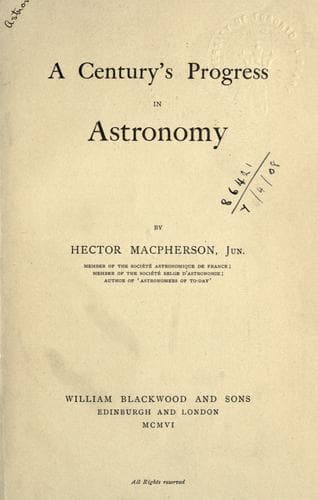
A Century's Progress in AstronomyMacpherson, Hector
History
A Century's Progress in Astronomy
Macpherson, Hector
Astronomy -- History
theory—Faye’s hypothesis—Ball’s exposition—The meteoritic
theory of Proctor—Its extension by Lockyer—Evolution of
the stars—Vogel’s order of evolution—Tidal friction: work
of Darwin—See’s explanation of double stars—Future of the
Universe
A CENTURY’S PROGRESS IN ASTRONOMY.
CHAPTER I.
HERSCHEL THE PIONEER.
In astronomy, as in other sciences, the past hundred years has been a
period of unparalleled progress. New methods have been devised, fresh
discoveries have been made, new theories have been propounded; the field
of work has widened enormously. In fact, the science of the heavens has
become not only boundless in its possibilities, but more awe-inspiring
and marvellous.
To whom in the main is this great advance due? To the great pioneer of
what may be called modern astronomy—William Herschel. Not only did
Herschel reconstruct the science and widen its bounds, but his powerful
genius directed the course of nineteenth century research. As an
astronomical observer he has never been surpassed. In the breadth of his
views he was equalled only by Newton; and indeed he excelled Newton in
his unwearied observations and his sweeping conceptions of the Universe.
To quote his own remark to the poet Campbell, he “looked farther into
space than ever human being did before him.”
Herschel studied astronomy in all its aspects. In all the branches of
modern astronomy he was a pioneer. He observed the Sun, Moon, and
planets, devoting special attention to Mars and Saturn. He doubled the
diameter of the Solar System by the discovery of Uranus. He discovered
several satellites and studied comets. He was pre-eminently the founder
of sidereal astronomy. He discovered binary stars, thus tracing the law
of gravitation in the distant star-depths; while to him is due the
credit of the discovery of the motion of the Solar System. He founded
the study of star-clusters and nebulæ, propounded the nebular
hypothesis, and devised two methods of star-gauging. Above all, he was
the first to attempt the solution of one of the noblest problems ever
attacked by man—the structure of the Universe. In fact, the latter
problem was the end and aim of his observations. As Miss Clerke remarks,
“The magnificence of the idea, which was rooted in his mind from the
start, places him apart from and above all preceding observers.” Most of
the departments of modern astronomy find a meeting-place in Herschel, as
the branches run to the root of the tree. He discussed astronomy from
every point of view. Before, however, proceeding to examine the work of
this great man, it is well to note a few of his characteristics. These
characteristics, once understood, give us the key to his researches.
Before we can master Herschel the astronomer we must understand Herschel
the man.
Public-domain text, read in full here on John Shaqi.
Reviews
Reviews
No reviews yet
Be the first to share your thoughts on this work.
Join the Discussion
Join the discussion
Sign in to leave a comment or review.
Sign InorCreate an account