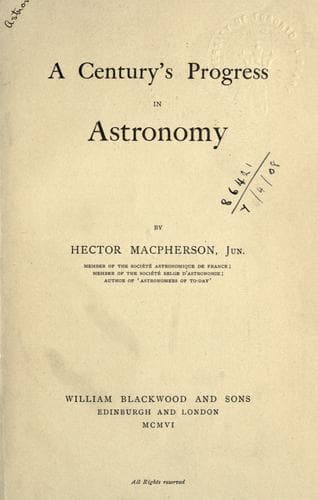
A Century's Progress in AstronomyMacpherson, Hector
History
A Century's Progress in Astronomy
Macpherson, Hector
Astronomy -- History
Of all the planets Mars has been most studied during the nineteenth
century. Many illustrious astronomers have devoted years to the study of
the red planet, with the result that more is known of the surface of
Mars than of any other celestial body, with the exception of the Moon.
After the time of Herschel, the leading students of Mars were Beer and
Mädler, who carefully studied the planet from 1828 to 1839. They
identified at each opposition the same dark spots, frequently obscured
by mists, and they also made the most accurate determination of the
rotation period, which they fixed at 24 hours 37 minutes 23 seconds.
This estimate was confirmed in 1862 by _Friedrich Kaiser_ (1808-1872) of
Leyden, in 1869 by _Richard Anthony Proctor_ (1837-1888), and in 1892 by
_Henricius Gerardus van de Sande Bakhuyzen_ (born 1838), director of the
Leyden Observatory. In 1862 Lockyer identified the various markings seen
by Beer and Madler in 1830. The other great names in Martian study prior
to 1877 are Angelo Secchi and _William Rutter Dawes_ (1799-1868), who
studied Mars from 1852 to 1865 and secured a very valuable series of
drawings. These drawings were used by Proctor for the construction of
the first reliable map of Mars, which was published in 1870 in his work,
‘Other Worlds than Ours.’ Proctor gave names to the various Martian
features, the reddish-ochre portions of the disc being named continents
and the bluish-green portions seas; and Proctor’s views on Mars found
favour for many years. In 1877, however, Schiaparelli opened a new era
in the study of Mars. In September of that year, during the very
favourable opposition of the planet, Schiaparelli, while executing a
trigonometrical survey of the disc, discovered that the continents were
cut up by numerous long dark streaks, which he called _canali_. In 1879,
to his surprise, he found that some of the canals had become double; and
he confirmed this in 1881 and at subsequent oppositions. Meanwhile, as
Schiaparelli was the only observer who had hitherto seen the canals,
there was much scepticism as to their reality. In 1886, however, they
were seen at the Nice Observatory by _Henri Perrotin_ (1845-1904), who
also observed their duplication. Since 1886 they have been observed by
many astronomers, including Camille Flammarion in France, _William
Frederick Denning_ (born 1848) in England, _Vincenzo Cerulli_ (born
1859) in Italy, Percival Lowell and W. H. Pickering in the United
States. In 1892 W. H. Pickering successfully observed the canals, and
discovered at the junctions of two or more canals round black spots, to
which he gave the name of “lakes,” in keeping with the view that the
dark regions of the planet were seas.
Public-domain text, read in full here on John Shaqi.
Reviews
Reviews
No reviews yet
Be the first to share your thoughts on this work.
Join the Discussion
Join the discussion
Sign in to leave a comment or review.
Sign InorCreate an account