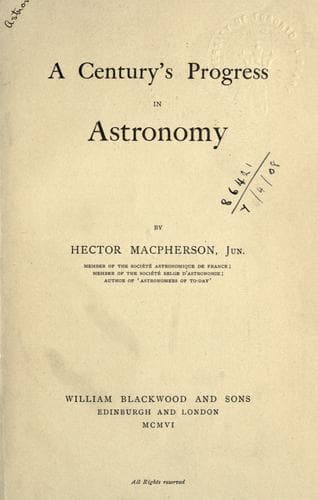
A Century's Progress in AstronomyMacpherson, Hector
History
A Century's Progress in Astronomy
Macpherson, Hector
Astronomy -- History
In 1894 Percival Lowell erected at Flagstaff, Arizona, an observatory
for the specific purpose of observing Mars and its canals in good and
steady air. He was assisted by W. H. Pickering and by _Andrew Ellicott
Douglass_ (born 1867). During a year’s study Douglass measured the
Martian atmosphere and discovered canals crossing the dark regions of
the planet, finally disproving the idea of their aqueous character.
Lowell recognised all Schiaparelli’s canals, and discovered many more.
He also attentively studied the south polar cap of Mars, which
disappeared entirely on October 12, 1894. Lowell noticed, also, that as
the cap melted the canals became darker, as if water was being conveyed
down; and accordingly he adopted the view put forward by Schiaparelli,
that the canals are waterways lined on either side by banks of
vegetation. His observations were published in the end of 1895 in his
work ‘Mars.’ He is of opinion that the reddish-ochre regions or
“continents” are deserts, and the greenish areas marshy tracts of
vegetation. The lakes are named by him “oases,” and, as Miss Clerke
observes, he “does not shrink from the full implication of the term.” He
regards the canals as strips of vegetation fertilised by a small canal,
much too small to be seen, an idea which originated with W. H.
Pickering. The canals are believed by Lowell to be waterways down which
the water from the melting polar cap is conveyed to the various oases.
He considers, in fact, that the canals are constructed by intelligent
beings with the express purpose of fertilising the oases, regarded by
him as centres of population. He remarks that water is scarce on the
planet, owing to its small size, and as a consequence the inhabitants
are forced to utilise every drop. The canal system is the result.
Public-domain text, read in full here on John Shaqi.
Reviews
Reviews
No reviews yet
Be the first to share your thoughts on this work.
Join the Discussion
Join the discussion
Sign in to leave a comment or review.
Sign InorCreate an account