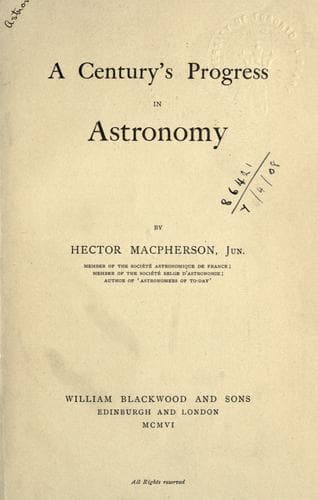
A Century's Progress in AstronomyMacpherson, Hector
History
A Century's Progress in Astronomy
Macpherson, Hector
Astronomy -- History
In 1870 _Arthur Cowper Ranyard_ (1845-1894), the well-known English
astronomer, began to collect records of unusual phenomena on the Jovian
disc to see if any period regulated their appearance. He came to the
conclusion that, on the whole, there was harmony between the markings on
Jupiter and the eleven-year period on the Sun. The theory of inherent
light in Jupiter, however, has not been confirmed. The great planet was
examined spectroscopically by Huggins from 1862 to 1864, and by Vogel
from 1871 to 1873. The spectrum showed, in addition to the lines of
reflected sunlight, some lines indicating aqueous vapour, and others
which have not been identified with any terrestrial substance. A
photographic study of the spectrum of Jupiter was made at the Lowell
Observatory by Slipher in 1904, probably the most exhaustive
investigation on the subject. The spectroscope has, however, given
little support to the theory of inherent light, and “we are driven to
conclude that native emissions from Jupiter’s visible surface are local
and fitful, not permanent and general.”
Herschel’s idea, that the rotations of the four satellites of Jupiter
were coincident with their revolutions, has on the whole been confirmed
by recent researches, although in the case of the two near satellites
(Io and Europa) W. H. Pickering’s observations in 1893 indicated shorter
rotation periods. There is much to learn regarding the geography of the
satellites, although in 1891 Schaeberle and Campbell at the Lick
Observatory observed belts on the surface of Ganymede, the third
satellite analogous to those on Jupiter. Surface-markings on the
satellites have also been seen by Barnard at the Lick Observatory, and
by Douglass at Flagstaff.
Since the time of Galileo no addition had been made to the system of
satellites revolving round Jupiter. Profound surprise was created,
therefore, by the announcement of the discovery of a fifth satellite by
Barnard at the Lick Observatory, on September 9, 1892. The satellite,
one of the faintest of telescopic objects, was discovered with the great
36-inch telescope, and its existence was soon confirmed by _Andrew
Anslie Common_ (1841-1903), with his great 5-foot reflector at Ealing,
near London. The new satellite was found by Barnard to revolve round
Jupiter in 11 hours 57 minutes at a mean distance of 112,000 miles.
Public-domain text, read in full here on John Shaqi.
Reviews
Reviews
No reviews yet
Be the first to share your thoughts on this work.
Join the Discussion
Join the discussion
Sign in to leave a comment or review.
Sign InorCreate an account