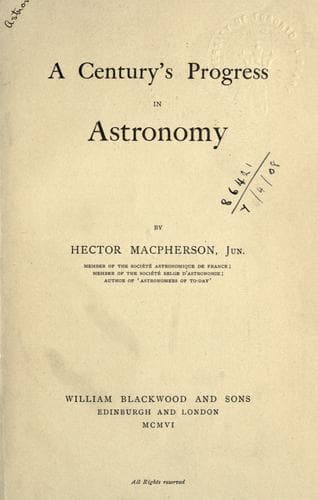
A Century's Progress in AstronomyMacpherson, Hector
History
A Century's Progress in Astronomy
Macpherson, Hector
Astronomy -- History
Although the existence of other satellites of Jupiter was predicted by
Sir _Robert Stawell Ball_ (born 1840) soon after the discovery of the
fifth, much surprise was created by the announcement, in January 1905,
that a sixth satellite had been discovered by Perrine, who, in the
following month, announced the discovery of a seventh. These discoveries
were made by photography, the objects being very faint. The periods of
revolution were found to be 242 days and 200 days for the sixth and
seventh satellites respectively, the mean distances being 6,968,000 and
6,136,000 miles. It is possible that they may belong to a zone of
asteroidal satellites. In fact, the fifth moon may belong to a similar
zone, so that Jupiter may have two asteroidal zones; but this is
anticipating future discovery.
A particular charm has always attached itself to the study of Saturn,
the ringed planet. The magnificent system of rings has for two and a
half centuries been the object of wonder and admiration in the Solar
System, and accordingly they have been exhaustively studied by many
eminent observers. While observing the two bright rings of Saturn on
June 10, 1838, Galle noticed what Miss Clerke calls “a veil-like
extension of the lucid ring across half the dark space separating it
from the planet.” No attention, however, was paid to Galle’s
observation. On November 15, 1850, _William Cranch Bond_ (1789-1859), of
the Harvard Observatory in Massachusetts, discovered the same phenomenon
under its true form—that of a dusky ring interior to the more brilliant
one. A fortnight later, before the news of Bond’s observation, Dawes
made the same discovery independently at Wateringbury in England. This
ring is known as the dusky or “crape” ring.
Public-domain text, read in full here on John Shaqi.
Reviews
Reviews
No reviews yet
Be the first to share your thoughts on this work.
Join the Discussion
Join the discussion
Sign in to leave a comment or review.
Sign InorCreate an account