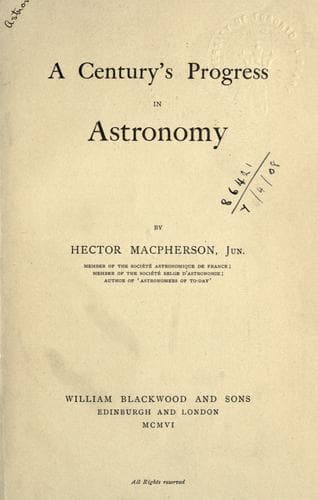
A Century's Progress in AstronomyMacpherson, Hector
History
A Century's Progress in Astronomy
Macpherson, Hector
Astronomy -- History
Richard Anthony Proctor, born at Chelsea, in London, in 1837, graduated
at Cambridge in 1860. For the next twenty-eight years he earned his
living by publishing many volumes on astronomy, popular and technical,
fifty-seven having appeared at the time of his death, which took place
at New York on September 12, 1888. Notwithstanding the vast amount of
work bestowed on his books, his original investigations were permanent
contributions to astronomical science. In 1870 he undertook to chart the
directions and amounts of 1600 proper motions. While engaged on this
work, it occurred to him that it would be “desirable and useful to
search for subordinate laws of motion.” He found, from the laborious
process of charting, that five of the seven stars of the Plough had a
motion in common—that is to say, were moving in the same direction at
the same rate. This phenomenon was termed by Proctor “star-drift.” He
also recognised other instances of star-drift in other portions of the
heavens.
The subject was soon afterwards taken up by the French astronomer,
Camille Flammarion. Born in 1842 at Montigny-le-Roi, in Haute Marne,
Flammarion was appointed assistant to Le Verrier in 1858, but gave up
his post in 1862. Employed successively at the Bureau des Longitudes,
and as editor of scientific papers, he founded in 1882 his private
observatory at Juvisy-sur-Orge, where he has since continued his
investigations.
Following up Proctor’s discovery of star-drift, Flammarion drew charts
of proper motions. He demonstrated the “common proper motion” of Regulus
and an eighth-magnitude star, Lalande 19,749, from a comparison of his
measures in 1877 with those of Christian Mayer a century previously;
while he discovered many other instances. His reflections on these
motions, as given in his ‘Popular Astronomy,’ are worthy of
reproduction: “Such are the stupendous motions which carry every sun,
every system, every world, all life, and all destiny in all directions
of the infinite immensity, through the boundless, bottomless abyss; in a
void for ever open, ever yawning, ever black, and ever unfathomable;
during an eternity, without days, without years, without centuries, or
measures. Such is the aspect, grand, splendid, and sublime, of the
universe which flies through space before the dazzled and stupefied gaze
of the terrestrial astronomer, born to-day to die to-morrow, on a
globule lost in the infinite night.”
Public-domain text, read in full here on John Shaqi.
Reviews
Reviews
No reviews yet
Be the first to share your thoughts on this work.
Elsewhere in the archive
Join the Discussion
Join the discussion
Sign in to leave a comment or review.
Sign InorCreate an account