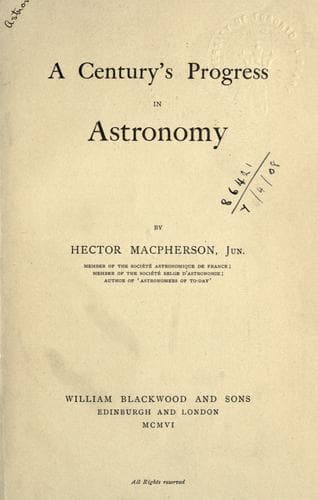
A Century's Progress in AstronomyMacpherson, Hector
History
A Century's Progress in Astronomy
Macpherson, Hector
Astronomy -- History
Measures of proper motion only enable us to determine the motion of
stars across the line of sight. They do not tell us whether the star is
advancing or receding. Here, however, the spectroscope comes to our aid
by means of Doppler’s principle, described in the chapter on the Sun. It
occurred to Huggins that, by observing the displacement of the lines in
the spectra of the stars, he could determine their motion in the line of
sight. His first results were announced in 1868. In the case of Sirius,
the displacement of the line marked F was believed to indicate a
velocity of recession of 29 miles a second. Some time later Huggins
announced that Betelgeux, Rigel, Castor, and Regulus were retreating,
while Arcturus, Pollux, Vega, and Deneb were approaching. Soon after
this successful work the subject was taken up by Maunder at Greenwich
and by Vogel at Bothkamp; but the delicacy of the measurements prevented
satisfactory results from being reached through visual observations, and
accordingly the measurements were very discordant.
In 1887 H. C. Vogel, working at Potsdam Astrophysical Observatory,
applied photography to the measurement of radial motion. Assisted by
_Julius Scheiner_ (born 1858), he determined the radial motions of
fifty-one bright stars by photographing the stellar spectra and
measuring the photographs. Vogel found 10 miles a second to be the
average velocity of stars in the line of sight, the tendency of the eye
being to exaggerate the displacements. The swiftest of the stars
measured by Vogel proved to be Aldebaran, with a velocity of recession
of 30 miles a second. Since 1892 the subject has been pursued by Vogel
himself with the new 30-inch refractor at Potsdam, by Campbell at the
Lick Observatory, Bélopolsky at Pulkowa, and other observers. Towards
the end of 1896 Campbell undertook, with the 36-inch Lick refractor, a
series of measures on radial motion, and many important discoveries were
made. These, however, must be reserved for the chapter dealing with
double stars.
Herschel’s great discovery, from the apparent motions of the stars, of
the movement of the Solar System was not accepted by the next generation
of astronomers. Bessel declared in 1818 that there was absolutely no
evidence to show that the Sun was moving towards Hercules. Even Sir John
Herschel rejected his father’s views, although some confirmatory results
had been reached by Gauss. At length, in 1837, Argelander, in a
memorable paper, based on his observations at Abo, in Finland, attacked
the problem, and demonstrated, from a discussion of the motions of 390
stars, quite independently of Herschel’s work, that the Solar System was
moving towards Hercules. This was confirmed in 1841 by Otto Struve, in
1847 by _Thomas Galloway_, and in 1859 and 1863 by Airy and _Edwin
Dunkin_ (1821-1898), assistant at Greenwich Observatory.
Public-domain text, read in full here on John Shaqi.
Reviews
Reviews
No reviews yet
Be the first to share your thoughts on this work.
Elsewhere in the archive
Join the Discussion
Join the discussion
Sign in to leave a comment or review.
Sign InorCreate an account