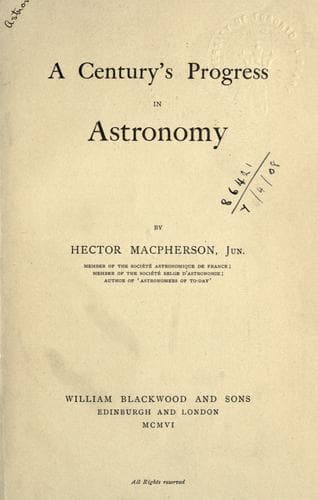
A Century's Progress in AstronomyMacpherson, Hector
History
A Century's Progress in Astronomy
Macpherson, Hector
Astronomy -- History
Meanwhile, in 1886, _Arthur Auwers_, permanent Secretary of the Berlin
Academy of Sciences, completed the re-reduction of Bradley’s
observations at Greenwich, and brought out 300 reliable proper motions,
which were utilised by Ludwig Struve, whose investigation removed the
solar apex from Hercules to the neighbouring constellation Lyra: this
slight change was confirmed by _Oscar Stumpe_, of Bonn, and _Lewis_
_Boss_ (born 1847), director of the Observatory at Albany, New York. An
investigation by Newcomb fully confirmed the previous results. In 1900,
1901, and 1902 Kapteyn made three distinct investigations on the solar
motion, and still further confirmed the previous investigations.
These investigations are fully confirmed by the application to the
question of Doppler’s principle of measuring radial motion. The
spectroscopic researches of Campbell at the Lick Observatory place the
solar apex very near the position assigned to it by Newcomb and Kapteyn.
Campbell finds the solar velocity to be about 12 miles a second, and
Kapteyn thinks a velocity of about 11 miles a second is “the most
probable value that can at present be adopted.”
CHAPTER X.
THE LIGHT OF THE STARS.
“That a science of stellar chemistry should not only have become
possible, but should already have made material advances, is assuredly
one of the most amazing features in the swift progress of knowledge our
age has witnessed.” So writes Miss Agnes Mary Clerke, the historian of
modern astronomy. As long ago as 1823 Fraunhofer observed the spectra of
the brighter stars, and gathered the first hint of the grouping of the
stars into three classes. Then, after Fraunhofer’s death, the subject
lay in abeyance for thirty-seven years. At length, in 1860, on
Kirchhoff’s explanation of the Fraunhofer lines, the study of stellar
spectra was inaugurated at Florence by Donati, who carefully fixed the
positions of the more important lines. His instrumental means, however,
were very limited, and his observations were not successful. In 1862
Rutherfurd, in New York, commenced the study of stellar spectra, but
shortly afterwards turned his attention to astronomical photography. The
actual founders of stellar spectroscopy were the eminent Italian
observer, Angelo Secchi, and the illustrious Englishman, William
Huggins.
Public-domain text, read in full here on John Shaqi.
Reviews
Reviews
No reviews yet
Be the first to share your thoughts on this work.
Elsewhere in the archive
Join the Discussion
Join the discussion
Sign in to leave a comment or review.
Sign InorCreate an account