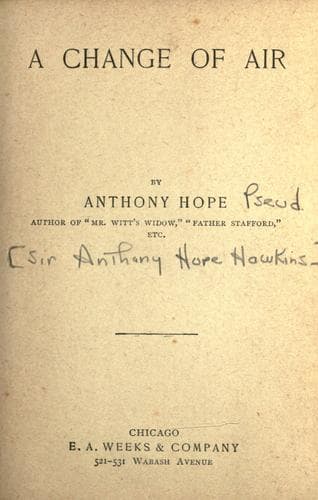
Country homes -- Fiction; England -- Social life and customs -- 19th century -- Fiction; Fame -- Fiction; Poets -- Fiction
The last of these books was by Anthony Hope Hawkins, whom Mr. Lang thus
classed among potential immortals. This romance has made him within the
last three months fairly famous. Walter Besant, too, has stamped it
with his high approval, and the English and American press have been
unusually unanimous in their praise.
Its hero is a rare and striking figure, and thoroughly represents the
ideal soldier of our Anglo-Saxon race. He faces great dangers and does
brave deeds, quietly and quickly. He suffers and loves deeply, but says
little. In his portrayal, the possibilities of "repressed emotion" have
been startlingly indicated. He appeals to Americans and English far
more than the swaggering and loquacious, though more historic heroes of
Dumas and his school ever can.
Much curiosity has been excited regarding "Anthony Hope."
The author's methods of composition and what may have suggested the
very original plot are as yet unknown. Besides what we may get from
his portrait, we are told that he is "a tall, thin, dark man, with a
face that would be ascetic if it were not bubbling with humor." He is a
lawyer, as other good romancers have been before him, and has chambers
in the Middle Temple, a place made famous in fiction by Thackeray and
on the stage by Pinero. His profession and politics are his chief
concerns, and literature a diversion in his leisure hours. He is an
extremely modest man, and in response to a request from his American
publishers for autobiographical matter, gave the barest facts of his
life. He expressed absolutely no opinion on literary canons or on his
own work. There was, however, a rare sincerity and cordiality in his
letters.
Anthony Hope Hawkins was born in 1863, his father being the Rev. E.
C. Hawkins of St. Brides, Fleet Street, London. He was educated at
Marlborough, and at Balliol College, Oxford, of which he was a scholar.
At Oxford, he was a hard worker and obtained first classes in Classical
Moderations and in the School of Litteræ Humaniores, commonly known as
"Greats." At this university, where he attained the degree of M. A.
some eight years ago, he began to show an aptitude for public life, was
a striking figure among his contemporaries, and became president of the
Union. In 1892 he stood as a Liberal candidate for a seat in Parliament
from the southern division of Buckinghamshire, but was defeated by
Viscount Curzon.
His first book, "A Man of Mark," was published in 1890, and was
followed next year by "Father Stafford," an interesting study of an
Anglican priest's struggles between love and sense of obligation to his
vow of celibacy. The pictures of his cheerless ascetic life are marked
by the sincerity conspicuous in Mr. Hawkins' later books. Some very
thoughtful conversations on art and on religion are introduced.
Public-domain text, read in full here on John Shaqi.
Reviews
Reviews
No reviews yet
Be the first to share your thoughts on this work.
Join the Discussion
Join the discussion
Sign in to leave a comment or review.
Sign InorCreate an account