Country homes -- Fiction; England -- Social life and customs -- 19th century -- Fiction; Fame -- Fiction; Poets -- Fiction
In 1892 appeared "Mr. Witt's Widow, a Frivolous Tale" of a lady who
had "harmonious contrasts," such as dark eyes and golden hair. It
foreshadows the power in plot-making that characterizes our author's
later works.
In the spring of 1893 appeared "Sport Royal," a collection of Mr.
Hawkins' short stories, mostly from the _St. James' Gazette_.
In "Half a Hero," published last year, there are several foreshadowings
of "The Prisoner of Zenda." In both stories the scene is imaginary,
but given realism by characteristics respectively of New Zealand and
of Germany; in both intrigues and heroism are conspicuous, though in
the latter the author did not adopt the old device of giving his hero
some bad qualities to make him human. "Half a Hero" contains much firm,
crisp character-drawing, and a strong love interest, but has the slight
taint of the "purpose novel," already noted in Father Stafford; in this
case, the discussion being politics, especially the "labor" element.
Anthony Hope inherited refinement through a father in an exalted
calling; he used his college advantages to the utmost, and now his
interests are in living public affairs, and in his chosen calling as a
lawyer, he has good opportunities to study life, and seems already to
have well mastered the best elements of Anglo-Saxon character. From his
work, he appears to have read widely and with a sympathetic eye for the
merits of markedly diverse writers, which he seems to make his own. His
style has the terseness and suggestiveness characteristic of Kipling,
but without his harshness, and at times he shows a sense of beauty
almost worthy of our own Hawthorne, and withal the military dash and
snap of Lever. It would be strange if the foundation for the remarkably
life-like colonists of "Half a Hero," and the German officers of "The
Prisoner of Zenda," had had not been laid by travel and the observation
of their more or less remote prototypes.
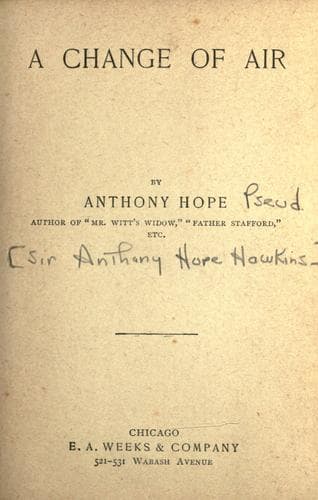
"A Change of Air," while containing much of its humor and snap,
furnishes a marked contrast to "The Prisoner of Zenda," and is in
a more serious vein, having a strong and tragic undercurrent, and
not without an element of peril. Confining its occurrences pretty
severely to the possible and generally probable, it nevertheless is
highly original. Dale Bannister, the wild young poet, who commences by
thoroughly scandalizing Market Denborough, is a most picturesque and
uncommon character. The effect of his early principles on his later
life is deftly indicated. The story moves on steadily, and while it
teaches a lesson of moderation and charity, it does so entirely by the
acts and thoughts of the characters without any sermonizing on the part
of the author. Some good authorities that have seen this book place
it even above "The Prisoner of Zenda," which we probably shall see on
the stage next year, as the author has a friend busily engaged on its
dramatization.
R. H.
_July, 1894._
Public-domain text, read in full here on John Shaqi.
Reviews
Reviews
No reviews yet
Be the first to share your thoughts on this work.
Join the Discussion
Join the discussion
Sign in to leave a comment or review.
Sign InorCreate an account