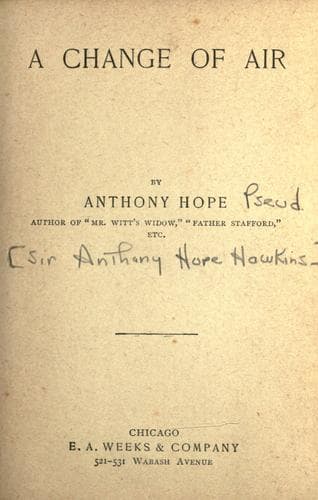
Country homes -- Fiction; England -- Social life and customs -- 19th century -- Fiction; Fame -- Fiction; Poets -- Fiction
A CHANGE OF AIR.
CHAPTER I.
=A Mission to the Heathen.=
When the Great King, that mirror of a majesty whereof modern times
have robbed the world, recoiled aghast from the threatened indignity
of having to wait, he laid his finger with a true touch on a
characteristic incident of the lot of common men, from which it was
seemly that the state of God's Vicegerents should be free. It was a
small matter, no doubt, a thing of manners merely, and etiquette; yet
manners and etiquette are first the shadowed expression of facts and
then the survival of them; the reverence once paid to power, and now
accorded, in a strange mixture of chivalry and calculation, to mere
place whence power has fled. The day of vicegerents is gone, and the
day of officers has come; and it is not unknown that officers should
have to wait, or even--such is the insolence, no longer of office,
but of those who give it--should altogether go without. Yet, although
everybody has now to wait, everybody has not to wait the same length of
time. For example, a genius needs not wait so long for what he wants
as a fool--unless, as chances now and then, he be both a genius and a
fool, when probably his waiting will be utterly without end.
In a small flat in Chelsea, very high toward heaven, there sat one
evening in the summer, two young men and a genius; and the younger of
the young men, whose name was Arthur Angell, said discontentedly to the
genius:
"The brute only sent me ten and sixpence. What did you get for yours?"
The genius blushed and murmured apologetically:
"That agent chap I've sold myself to got twenty pounds for it."
The second young man, who was not so young, being, in fact, well
turned of thirty, and growing bald, took his pipe out of his mouth,
and, pointing the stem first at the genius, then at Arthur Angell, and
lastly, like a knife, at his own breast, said:
"Pounds--shillings--and pence. He sent me nothing at all."
A pause followed, and the genius began:
"Look here, you fellows----" But Philip Hume went on: "Ten and sixpence
is a good sum of money, a comfortable sum of money, and, my dear
Arthur, I should say the full value of your poem. As to Dale's poem,
who knows the value of Dale's poem? By what rod shall you measure----"
He broke off with a laugh at Dale's gesture of protest.
"I'm making the deuce of a lot of money," said Dale in an awestruck
tone. "It's rolling in. I don't know what to do with it."
"Littlehill will swallow it," said Philip.
"You don't mean that he sticks to that idea?" exclaimed Arthur. "You
don't, do you, Dale?"
"I do," answered Dale. "I'm not going permanently. I'm not going to
forsake our old ways or our old life. I'm not going to turn into a rich
man."
"I hope not, by Jove!" cried Arthur.
"But I want to see the country--I've not seen it for years. And I want
to see country people, and--and----"
"It'll end in our losing you," prophesied Arthur gloomily.
Public-domain text, read in full here on John Shaqi.
Reviews
Reviews
No reviews yet
Be the first to share your thoughts on this work.
Join the Discussion
Join the discussion
Sign in to leave a comment or review.
Sign InorCreate an account