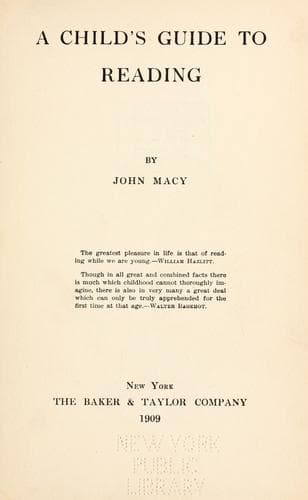
Books and reading; Children's literature -- Bibliography
If we are not persuaded that our soul’s good depends on a knowledge
of foreign languages, we can make the acquaintance of the classics of
other nations in the best English renderings. Our greatest book, the
King James Bible, is a translation, so great a translation that in
point of style it is said by some critical scholars to be better than
its Greek and Hebrew originals. In general it is true that translation
falls below the original or radically changes its character. Until
the nineteenth century, when the scholars of our race began to give
us literal translations of the classics, which although “literal”
are still idiomatic English, translators in our tongue have been, as
a rule, willful conquerors who dominated the native spirit of their
originals with the overwhelming power of the English language and
spirit. They anglicized the foreign masterpiece so that its own father
would not recognize it. The result was often, as in Pope’s “Iliad,” a
new English classic but not a good pathway to the house of the foreign
poet.
Pope’s “Iliad” is a “classic” but it is poor Homer and not the best of
Pope. His genius is much better expressed in “The Rape of the Lock.”
And Homer’s genius is much better preserved for us in the simple prose
of Leaf, Myers, Butcher, and Lang. Professor G. H. Palmer’s “Odyssey”
is so good that no translator hereafter has a right to plead as excuse
for the failure of his version of any classic that “the English
language will not do it.” Matthew Arnold’s essay “On Translating Homer”
will stimulate the reader’s interest in the art of translation and help
bring him near to the Greek spirit. But this essay goes into subtleties
which may baffle the beginner. Any beginner, old enough to read at all,
can read Professor Palmer’s “Odyssey.” Many books of Greek stories and
legends of the heroes have been prepared for young readers. “Old Greek
Stories” by C. H. Hanson, or A. J. Church’s books of Greek life and
story, together with Bulfinch’s “Age of Fable,” will initiate one into
the Homeric mysteries.[5]
After the reader has advanced far enough to be interested in
philosophy, he will wish to read Epictetus and Plato. Jowett’s “Plato”
is one of the great translations of the nineteenth century. The reader
of Browning will not omit his noble, if somewhat difficult translation
of the “Agamemnon” of Æschylus. From the early Elizabethans to the
late Victorians the works of the English poets are starred with bits
from the Latin and Greek poets. One of the finest of translations from
the Greek is the “Theocritus” of Charles Stuart Calverley, the English
poet, who loved all things beautiful and enjoyed all things absurd.
Calverley’s translations from the classics and his delicious burlesques
and parodies will give one a new sense of how close together the
different moods of literature may lie in the same heart, both the heart
of the poet and the heart of the reader.
Public-domain text, read in full here on John Shaqi.
Reviews
Reviews
No reviews yet
Be the first to share your thoughts on this work.
Elsewhere in the archive
Join the Discussion
Join the discussion
Sign in to leave a comment or review.
Sign InorCreate an account