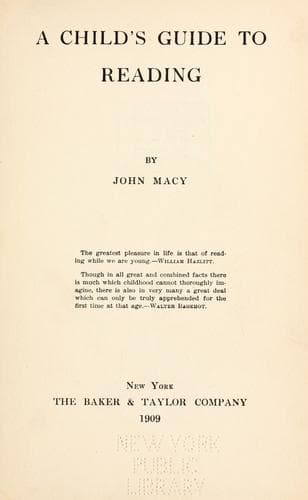
Books and reading; Children's literature -- Bibliography
Well, we have entered the classroom in which Mr. Saintsbury is
discoursing of Elizabethan literature, we have entered, so to speak,
by the side door. If our nature is at all shaped to receive profit and
enjoyment from the study of books, we shall be curious to see from
reading the whole of Mr. Saintsbury’s book what has led up to Chapman
and what writers succeed him. Of the various ways in which authors
may be grouped for analysis the historical is the best for the young
student; and it is on the historical scheme of division that most
studies of literature are based. A very useful series of books has been
begun under the editorship of Professor William A. Neilson in which
each volume deals with a class of literature, one with the essay, one
with the drama, one with ballads, and so on. This series, intended for
advanced students, will probably not be the best for the beginner,
though it is often true that works intended for advanced readers are
the very best for the young, and that books for young readers entirely
fail as introductions to more thorough studies. The reader who is
really interested in tracing out the relations between writers will
in good time wish to read studies of literature made on the historic
plan and also some which survey generic divisions of literature.
The two methods intersect at right angles. The main thoroughfare of
literary study which runs from the early story-tellers through Fielding
and Thackeray to Hardy and George Meredith, crosses the other great
thoroughfares: the one which follows the relations between Fielding,
Gray, Johnson, and Burke and other great men of that age; the one
which makes its way through the age of Wordsworth and passes from
Burns’s cottage to Scott’s Abbottsford; and the one through the age of
Victoria. This has been surveyed as far as George Meredith, and the
critics are busily putting up the fences and the sign posts.
In view of the limitations which mere time imposes on the number of
books which any individual may study, we shall resolve early not to
attempt the impossible, not to try to study with great intimacy the
entire range of literature. The thing to do is to select, or to allow
our natural drift of mind to select for us, one period of literature,
or one group, or one writer in a period. In ten years of leisurely but
thoughtful reading, after the day’s work is done, one can know, so
far as one’s given capacity will admit, as much about Shakespeare as
any Shakespeare scholar, that is, as much that is essential and worth
knowing. Not that ten years will exhaust Shakespeare or any other
great poet, but they will suffice for the laying of a foundation of
knowledge complete and adequate for the individual reader, and on that
foundation the individual can build his personal knowledge of the poet,
a structure in which the materials furnished by other students become
of decreasing importance.
Public-domain text, read in full here on John Shaqi.
Reviews
Reviews
No reviews yet
Be the first to share your thoughts on this work.
Elsewhere in the archive
Join the Discussion
Join the discussion
Sign in to leave a comment or review.
Sign InorCreate an account