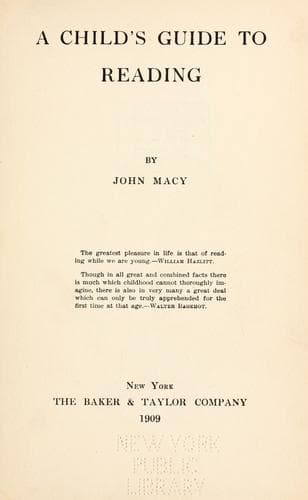
Books and reading; Children's literature -- Bibliography
To bring our discussion to a vital example, let us consider Thackeray’s
“Henry Esmond,” an all but perfect fiction, in which every element of
excellent narrative is present.
The first element is plot. A story must begin in an interesting set
of circumstances and arrive by a series of events to a conclusion
that satisfies. The plot of “Esmond” is unusually well made, and it
is composed of rich matter. From the first chapter in which Henry is
introduced to us as “no servant, though a dependent, no relative,
though he bore the name and inherited the blood of the house”--a
youth with a mystery--on through the schemes for the restoration of
the Stuart King, through Esmond’s unsuccessful rivalry with the other
suitors of Beatrice, to the end of the high intrigues of politics and
the quiet conclusion of Esmond’s career, the story moves steadily
with well-mannered leisure. It takes its own time, but it takes the
right time, slow when events are preparing, rapid and flashing when
events come to a crisis. The great crisis, when Esmond overtakes the
prince at Castlewood, breaks his sword and renounces both allegiance
to the Stuarts and his own birthright, is one of the supreme dramatic
scenes in literature. There Thackeray matches, even excels, Scott and
Dumas. And such is the variety of his power that on other pages he
writes brilliant and witty comedy surpassed only by the lighter plays
of Shakespeare, on yet other pages he gives compact lucid summary of
events, the skill of which an historian might envy, and again he writes
pages of comment on human character which equal the best pages of
Esmond’s friend, “the famous Mr. Joseph Addison.”
Public-domain text, read in full here on John Shaqi.
Reviews
Reviews
No reviews yet
Be the first to share your thoughts on this work.
Join the Discussion
Join the discussion
Sign in to leave a comment or review.
Sign InorCreate an account