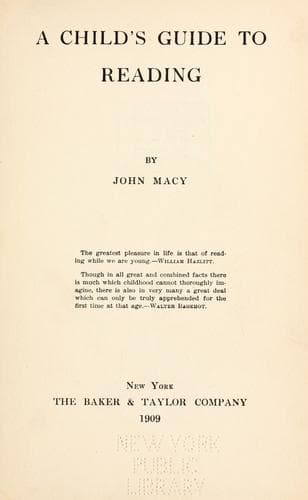
Books and reading; Children's literature -- Bibliography
No one can tell, either, where out of all this emerges that quality of
writing called style. Manner of expression is not a separable shell
in which the stuff is contained like a kernel. The manner is in the
substance. Yet there is a charm of words felt for itself which seems to
lie above and around the thing conveyed. In other books Thackeray loses
his plot, and sometimes apparently forgets his characters, and yet
he carries the reader on by virtue of saying things compellingly and
invitingly. When, as in “Esmond,” the order of action is so satisfying
and the people are so interesting to watch and be with, and in
addition every page is a delight to the ear, then literary excellence
is complete.
[Illustration: THACKERAY]
Here, united in one book, are the elements of fiction--plot, character,
description and style. And from these elements, however blended, there
results a total value, the measure of a book’s importance in relation
to the other things in life. This value is essentially moral, not so
much because literature is under peculiar obligations to preach and
teach morality as because it is part of life and the fundamental things
in life are moral in the large sense of the word. It is as impossible
to think of a fiction which shall be neither moral nor immoral as
to think of an act which shall be, in the modern meaningless word,
unmoral. Even a very slight fiction, like a trivial act, weighs on
one side or the other. All the best of our novelists have been fully
conscious of their ethical obligations to their readers. Having thought
deeply enough about life to write about it, they could not have failed
to think deeply about their professional responsibility, their part in
life.
I am going to quote at length a passage from Anthony Trollope’s “Life
of Thackeray” in the series of biographies known as _English Men of
Letters_. The young reader can find no better book about the novel than
this account of one great novelist by another. In spite of a current
idea that shop-talk is not interesting, a thoughtful craftsman talking
about his work is likely to be at his best. Moreover, Trollope’s
judgments on the moral obligation of the novelist are especially worthy
of confidence, for he is no heavy-handed preacher, no metaphysical
critic, but a broad-minded humorist, an affectionate student of human
nature, a cheerful workman who regarded his own books in a modest
businesslike way.
Public-domain text, read in full here on John Shaqi.
Reviews
Reviews
No reviews yet
Be the first to share your thoughts on this work.
Join the Discussion
Join the discussion
Sign in to leave a comment or review.
Sign InorCreate an account