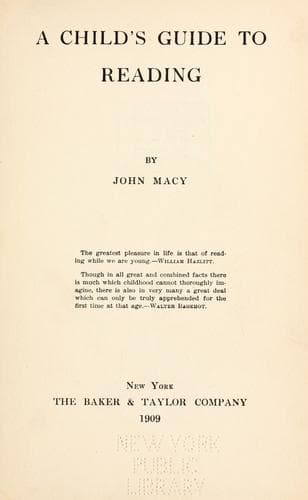
Books and reading; Children's literature -- Bibliography
“I have said previously,” says Trollope, “that it is the business
of a novel to instruct in morals and to amuse. I will go further,
and will add, having been for many years a prolific writer of novels
myself, that I regard him who can put himself into close communication
with young people year after year without making some attempt to do
them good, as a very sorry fellow indeed. However poor your matter
may be, however near you may come to that ‘foolishest of existing
mortals,’ as Carlyle presumes some unfortunate novelist to be, still,
if there be those who read your works, they will undoubtedly be more
or less influenced by what they find there. And it is because the
novelist amuses that he must be influential. The sermon too often has
no such effect, because it is applied with the declared intention of
having it. The palpable and overt dose the child rejects; but that
which is cunningly insinuated by the aid of jam or honey is accepted
unconsciously, and goes on upon its curative mission. So it is with
the novel. It is taken because of its jam and honey. But, unlike the
honest and simple jam and honey of the household cupboard, it is never
unmixed with physic. There will be the dose within it, either curative
or poisonous. The girl will be taught modesty or immodesty, truth or
falsehood; the lad will be taught honor or dishonor, simplicity or
affectation. Without the lesson the amusement will not be there. There
are novels which certainly can teach nothing; but then neither can they
amuse any one.
“I should be said to insist absurdly on the power of my own fraternity
if I were to declare that the bulk of the young people in the upper and
middle classes receive their moral teaching chiefly from the novels
they read. Mothers would no doubt think of their own sweet teaching;
fathers of the examples which they set; and schoolmasters of the
excellence of their instructions. Happy is the country that has such
mothers, fathers, and schoolmasters! But the novelist creeps in closer
than the schoolmaster, closer than the father, closer almost than the
mother. He is the chosen guide, the tutor whom the young pupil chooses
for herself. She retires with him, suspecting no lesson, safe against
rebuke, throwing herself head and heart into the narration as she can
hardly do into her task work; and there she is taught--how she shall
learn to love; how she shall receive the lover when he comes; how far
she should advance to meet the joy; why she should be reticent, and not
throw herself at once into this new delight. It is the same with the
young man, though he would be more prone even than she to reject the
suspicion of such tutorship. But he, too, will learn either to speak
the truth, or to lie; and will receive from his novel lessons either
of real manliness, or of that affected apishness and tailor-begotten
demeanor which too many professors of the craft give out as their
dearest precepts.
Public-domain text, read in full here on John Shaqi.
Reviews
Reviews
No reviews yet
Be the first to share your thoughts on this work.
Join the Discussion
Join the discussion
Sign in to leave a comment or review.
Sign InorCreate an account